Bio Shop
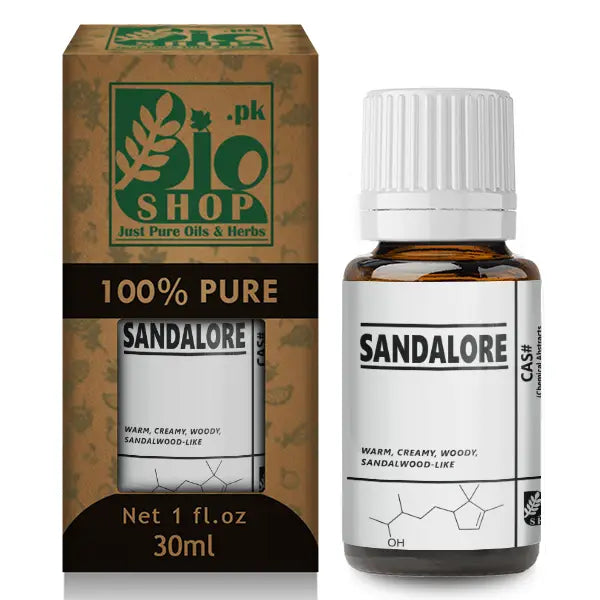
Sandalore
Sandalore
Olfactory Notes: Sandalwood · Creamy · Smooth · Woody · Warm · Long-lasting
Couldn't load pickup availability
Explore
Information About Sandalore
Key Features
✦ Synthetic sandalwood aroma chemical — creamy, milky, warm woody character with exceptional smoothness
✦ One of the most credible synthetic alternatives to rare and expensive Mysore sandalwood oil
✦ Dual-function ingredient — valued for both its fragrance performance and reported skin receptor-stimulating properties
✦ Excellent tenacity and fixative strength — extends the dry-down of floral, oriental, and woody compositions significantly
✦ IFRA 51st Amendment regulated — confirm category-specific usage limits before use in leave-on applications
✦ Versatile across fine fragrance, attars, luxury personal care, hair care, and premium home fragrance
✦ Vegan, cruelty-free, and free from animal-derived ingredients
About Sandalore
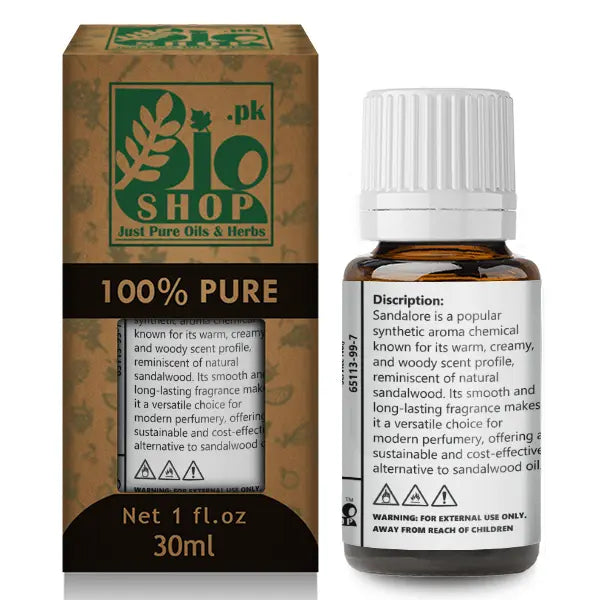
Sandalore is a trademarked synthetic aroma chemical created by Givaudan, one of the world's leading fragrance and flavour houses. It was developed as part of the ongoing industry effort to find high-performance, sustainably produced sandalwood alternatives following the severe depletion and strict harvesting controls placed on Santalum album, the Mysore sandalwood tree. Since its introduction, Sandalore has been adopted widely across fine fragrance and functional fragrance categories globally.
What distinguishes Sandalore from other synthetic sandalwood materials — such as Javanol, Polysantol, or Ebanol — is its distinctly creamy, milky, and soft character. It sits closer to the skin-like warmth of true East Indian sandalwood than the drier, more pencil-shaving facets of some competing molecules. Notably, research has explored Sandalore's interaction with olfactory receptors present in skin tissue, suggesting a potential role in keratinocyte migration and skin repair — a property that has attracted interest from cosmetic chemists beyond its use purely as a fragrance material.
Bio Shop Pakistan supplies cosmetic-grade Sandalore suitable for Pakistani DIY perfumers, attar blenders, luxury personal care formulators, and home fragrance crafters who require a reliable, high-quality sandalwood base note in their creative work.
Olfactory Profile
SCENT DESCRIPTION : Sandalore opens with a warm, smooth, milky-woody creaminess that settles almost immediately into a close, skin-hugging sandalwood accord. It carries the soft, almost edible sweetness of fresh-cut sandalwood heartwood alongside delicate lactonic undertones that give the material an intimate, powdery depth. Unlike some sharper synthetic sandalwood materials, Sandalore has a rounded, almost buttery quality that blends seamlessly into floral, musky, and oriental constructions without demanding attention. In the extended dry-down, it becomes a quiet but persistent woody foundation, clean and never sharp.
NOTE POSITION : Base / Mid-Base
FRAGRANCE FAMILY : Woody · Oriental · Soft Floral
FACETS : Creamy · Milky · Warm Woody · Powdery · Balsamic
TENACITY : High — 10 to 14 hours on skin, significantly longer on fabric
SILLAGE : Medium — intimate and close-skin rather than projecting, excellent for skin scent and personal care applications
Technical Specifications
Chemical Name : 3-(3,3-Dimethylcyclohexyl)-2-methylenebutan-1-ol (verify exact stereochemistry with supplier CoA)
CAS Number : 65113-99-7
Synonyms : Sandol, Givaudan Sandalore, Synthetic Sandalwood Alcohol
Purity : 95% minimum (verify with supplier CoA)
Appearance : Colorless to pale yellow clear liquid
Odor Threshold : Approximately 0.03–0.08 ppb (very potent — low usage rates are effective)
Solubility : Soluble in ethanol, IPM, DPG, mineral oil; insoluble in water
Specific Gravity : 0.940 – 0.960 at 20°C (verify with supplier)
Flash Point : Approximately 95–105°C (verify with supplier CoA)
Type : Synthetic aroma chemical
Applications & Usage Guidelines
Fine Fragrance : ★★★★★
Sandalore is a premier base note material for fine fragrance construction. Its creamy, milky-woody depth anchors floral, chypre, oriental, and woody compositions with credibility and smoothness. It pairs naturally with rose, jasmine, musks, amber, and oud to produce compositions of lasting elegance.
Attar and Oriental Blending : ★★★★★
In attar and oriental-style formulations, Sandalore performs exceptionally well as a synthetic backbone for oud, rose, and musk accords. It closely approximates the softness and warmth of genuine Mysore sandalwood oil, making it a cost-effective and sustainable substitute in traditional Arabic and South Asian fragrance styles.
Functional Fragrance : ★★★★☆
Sandalore is well-suited to hair care, body lotion, and skin care fragrancing due to its reported skin receptor activity and clean safety profile at recommended levels. It adds a warm, sophisticated, long-lasting woody base to personal care products with good substantivity on hair and skin.
Cosmetics and Skin Care : ★★★☆☆
Used within IFRA-compliant limits, Sandalore can contribute both fragrance and potential skin-conditioning interest in creams, serums, and body care. Formulators should observe leave-on category usage limits carefully and conduct QRA assessment for individual products.
Home Fragrance : ★★★★☆
Sandalore performs well in reed diffusers, room sprays, and wax melts where its warm woody creaminess rounds out green, floral, or spicy accords. It provides good diffusion and lasting character in ambient fragrance formats.
IFRA & Usage Rate
Recommended Starting Usage Rates
EDP (Eau de Parfum) : 1.0 – 3.0%
EDT (Eau de Toilette) : 0.8 – 2.0%
Body Lotion (Leave-On) : 0.5 – 1.0% (IFRA limit applies — see below)
Shampoo / Body Wash (Rinse-Off) : 1.0 – 2.0%
Candle : 2.0 – 5.0%
Reed Diffuser : 3.0 – 8.0%
Soap (Tablet) : 0.5 – 1.5%
IFRA 51st Amendment Compliance
⚠️ Sandalore is a regulated fragrance ingredient under the IFRA 51st Amendment due to skin sensitization potential. Usage limits vary by product category. The figures below are indicative — always verify against the current IFRA standard document and your supplier's IFRA certificate.
IFRA Category 1 (Lip products) : Approximately 0.08% (verify with supplier)
IFRA Category 4 (Body lotion) : Approximately 1.4% (verify with supplier)
IFRA Category 5A (Face cream) : Approximately 0.7% (verify with supplier)
IFRA Category 9 (Rinse-off body) : Approximately 2.5% (verify with supplier)
IFRA Category 11A (Candles) : No restriction specified (verify with supplier)
IFRA Category 12 (Non-skin contact) : No restriction specified (verify with supplier)
⚠️ Always obtain a current IFRA conformity certificate from your Sandalore supplier. Conduct QRA (Quantitative Risk Assessment) for any leave-on skin application, particularly facial products and lip-adjacent formulations.
⚠️ Sandalore may cause sensitization in susceptible individuals at excessive concentrations. Adhere to recommended levels and conduct patch testing guidance for end consumers.
Blending Guide
METHOD 1 — Predilution in DPG or IPM
Sandalore blends most smoothly when prediluted to a 10% solution in dipropylene glycol (DPG) or isopropyl myristate (IPM) before incorporation. This eases accurate dosing at low usage rates, prevents over-contribution of the woody note, and ensures even dispersion in both alcohol and carrier oil bases.
METHOD 2 — Sandalwood Accord Construction
To build a credible sandalwood accord without natural sandalwood oil, combine Sandalore with Javanol or Ebanol (if available) for multidimensional woody depth, add a small percentage of Iso E Super for radiance and projection, and round the base with a soft white musk such as Habanolide or Galaxolide. This three-component framework creates a naturalistic, smooth sandalwood effect suitable for fine fragrance and personal care.
METHOD 3 — Oriental and Attar Base
In attar-style or oriental compositions, use Sandalore as a foundational wood note beneath oud oil, rose absolute, and ambergris accords. Its milky softness bridges the gap between the resinous density of oud and the delicacy of floral notes, producing a composition of warmth and balance characteristic of traditional Arabic and Indo-Pakistani perfumery.
BEST PAIRINGS
Rose Absolute / Rose Oxide → Creamy floral-wood accord of classical elegance
Oud Oil / Oud Aroma Chemical → Warm, resinous oriental depth with sandalwood softness
Ambroxan → Skin-like, luminous, modern woody-amber effect
Iso E Super → Adds woody radiance and diffusion to the smooth base
Habanolide / Galaxolide → Soft musk-wood combination with excellent longevity
Benzyl Benzoate → Balsamic, diffusive warmth that deepens the oriental character
Hedione → Adds clean jasmine-like luminosity to the woody creaminess
Cedarwood Atlas / Cedryl Acetate → Dry, pencil-shaving cedar facets that contrast and balance the milky softness
AVOID
Pairing Sandalore with very high concentrations of green top notes such as CIS-3-Hexenol in isolation — the creamy milky quality can conflict with sharp green material unless carefully mediated by floral or citrus elements. Use at balanced ratios.
Perfumer's Note
When I first worked with Sandalore, what struck me was not its resemblance to sandalwood as an abstract concept but how intimately it recreates the feeling of sandalwood oil on warm skin. Most synthetic sandalwood materials have an edge — a dryness, a slight camphoraceous bite — that reminds you they are constructions rather than the real thing. Sandalore does not have that edge. It settles into a formulation like a natural material would: quietly, smoothly, and with genuine depth. In my experience it performs particularly well in oriental-leaning compositions built for the South Asian and Middle Eastern palate, where that creamy, close-skin warmth is expected and valued. I use it at 1 to 2 percent in most EDP constructions as a transparent wood scaffold rather than a statement note, which is where it gives the best return.
ADVANCED TIP : Build a three-layer sandalwood effect by using Sandalore at 1.5% for creamy milky body, Ambroxan at 0.3% for transparent skin-lift and diffusion, and a trace of Benzyl Benzoate at 0.5% for balsamic depth and trail. This combination does not read as sandalwood in any obvious or linear way — instead it produces the emotion of sandalwood: warmth, closeness, and the quiet impression of precious wood on skin. Apply this framework as the base layer beneath any floral or oriental accord and evaluate after 24 hours on a strip.
Safety & Storage
Physical State : Clear liquid at room temperature
Skin Safety : Use within IFRA 51st Amendment limits; patch test recommended for leave-on products; may cause sensitization in susceptible individuals at elevated concentrations
Eye Contact : Avoid direct contact; rinse thoroughly with clean water if contact occurs; seek medical advice if irritation persists
Ingestion : Not for internal use; keep away from children; seek medical attention if accidentally ingested
Ventilation : Use in a well-ventilated area; avoid prolonged inhalation of concentrated vapour
Storage : Store in a cool, dry location away from direct sunlight and heat sources; ideal temperature 15–25°C
Shelf Life : 24–36 months from manufacture date when stored correctly in sealed containers
Container : Store in original container or dark glass / HDPE with airtight lid; avoid reactive metals
Flammability : Combustible liquid; flash point approximately 95–105°C; keep away from open flame during handling
FAQ
Q: What is Sandalore and why is it used in perfumery?
A: Sandalore is a synthetic aroma chemical developed by Givaudan that reproduces the creamy, milky, warm-woody character of Mysore sandalwood oil. It is used as a sustainable, consistent, and cost-effective base note in fine fragrance, attars, and personal care.
Q: Is Sandalore a direct replacement for natural sandalwood oil?
A: It is not an exact replica, but it closely recreates the soft, creamy, skin-hugging quality that makes East Indian sandalwood distinctive. Many professional perfumers combine Sandalore with other sandalwood molecules like Javanol or Ebanol to build a fuller, more complex sandalwood effect.
Q: Can I use Sandalore in leave-on skin care products like body lotion?
A: Yes, but you must stay within the IFRA 51st Amendment limits for the relevant product category. For body lotion the indicative limit is approximately 1.4 percent — verify this against your supplier's IFRA certificate before formulating.
Q: What is the best way to measure and use Sandalore at low dosage rates?
A: Predilute Sandalore to a 10 percent solution in DPG or IPM, then weigh your desired final concentration from the dilution. This prevents errors at low dosage and ensures even blending into your formula.
Q: How does Sandalore compare to Javanol, another Givaudan sandalwood molecule?
A: Javanol (CAS 58567-11-6) has a cleaner, creamier, and more transparent sandalwood quality that reads closer to fresh-cut Santalum album heartwood. Sandalore has a slightly warmer, milkier, and denser character with stronger fixative behaviour. They are highly complementary and many perfumers use both together to construct a multidimensional sandalwood accord.
Where Can You Safely Use Sandalore?
Discover how Sandalore performs across different applications—rated for safety, stability, and effectiveness.