


Bio Shop
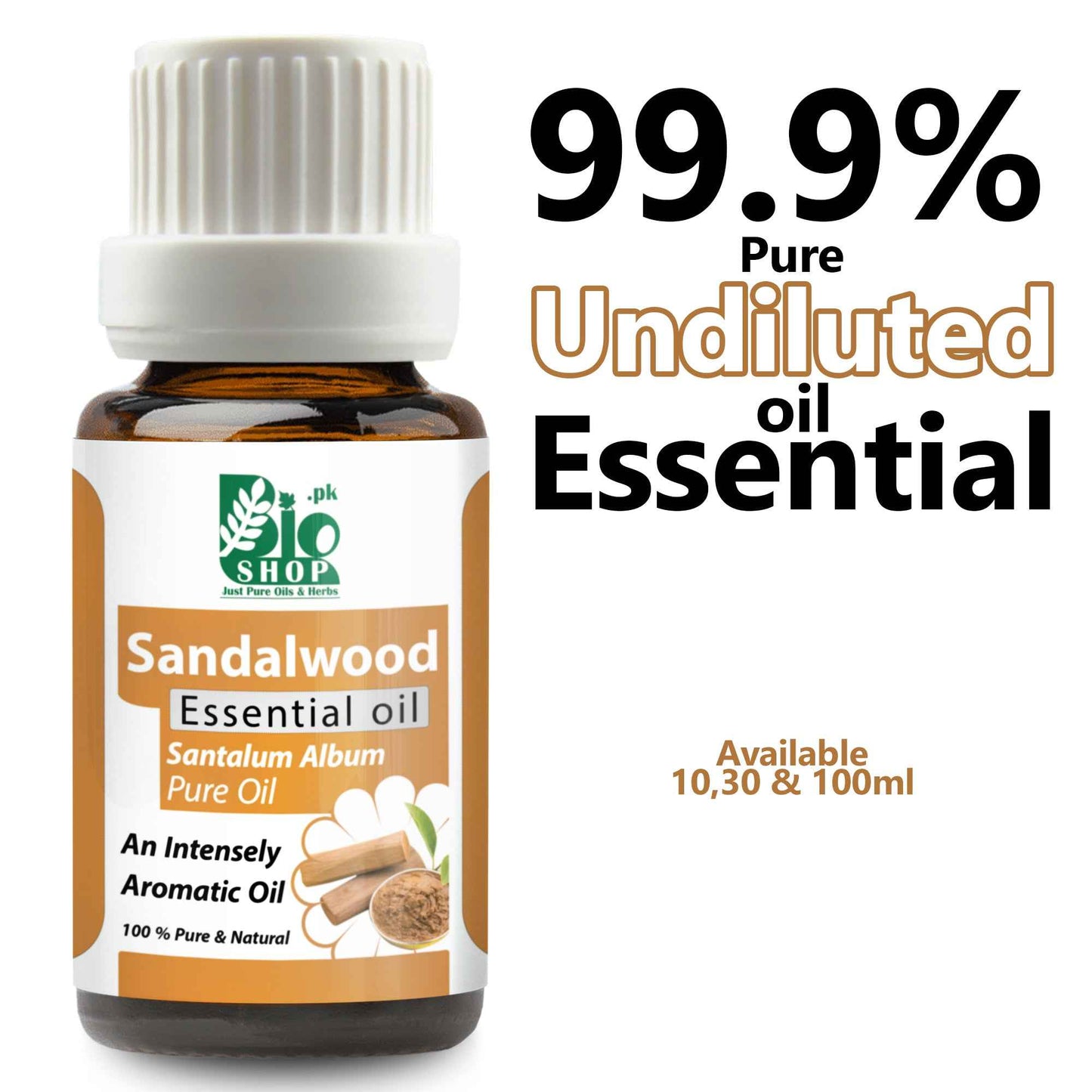
Sandalwood Essential Oil
Sandalwood Essential Oil
Olfactory Notes: Sandalwood · Creamy · Woody · Warm · Soft · Milky
Couldn't load pickup availability


Explore
Information About Sandalwood Essential Oil
Key Features
✦ Pure essential oil from Santalum album heartwood — one of the most coveted fragrance naturals in the world
✦ Rich in alpha-santalol (min. 45%) and beta-santalol (min. 20%) — the compounds responsible for its iconic creamy-woody scent
✦ Exceptional fixative and base note — extends the life of entire fragrance compositions
✦ Deeply skin-conditioning — used in luxury serums, face oils, and hair treatments for its emollient and soothing properties
✦ Core ingredient in traditional attars, oud blends, oriental perfumes, incense, and meditation oils
✦ Naturally derived, free from synthetic diluents — suitable for natural and clean beauty formulations
✦ Versatile across perfumery, skincare, haircare, incense, and home fragrance applications
About Sandalwood Essential Oil
South Asia, the Middle East, and East Asia. Steam-distilled from the heartwood and roots of mature Santalum album trees — typically requiring 25 to 30 years of growth — genuine Indian sandalwood oil is among the most labor-intensive and precious aromatic raw materials in existence. Its history spans sacred temple offerings, Ayurvedic medicine, royal perfumery, and Islamic itar traditions, making it a cultural cornerstone of fragrance across civilizations.
What sets Santalum album apart is its unique biochemical profile. The high concentration of santalol isomers creates a scent that is simultaneously woody, milky, sweet, and softly balsamic — a combination that no synthetic or substitute has fully replicated. Unlike many essential oils that fade quickly, sandalwood clings to the skin and fabric for hours, acting as a natural fixative that slows the evaporation of lighter aromatic compounds around it. This makes it irreplaceable in fine fragrance construction and an extraordinary carrier in attar-style concentration perfumery.
Bio Shop Pakistan supplies cosmetic-grade Sandalwood Essential Oil suitable for fine fragrance blending, traditional attar production, luxury skincare formulation, hair care products, incense making, and meditation applications — serving both hobbyist perfumers and professional formulators across Pakistan.
Olfactory Profile
SCENT DESCRIPTION : Sandalwood Essential Oil opens with a soft, milky warmth that quickly settles into a rich, creamy wood accord — deep but never harsh, smooth but never dull. There is a subtle sweetness running through its core, accompanied by faint balsamic and resinous undertones that give it a quiet density. On skin, it evolves slowly and intimately, growing warmer and more animalic over time. Its drydown is exceptionally smooth, lasting for hours as a velvety, woody skin-scent that seems to become part of the wearer.
NOTE POSITION : Base
FRAGRANCE FAMILY : Woody · Oriental · Balsamic
FACETS : Creamy · Milky · Warm Wood · Balsamic · Soft Resinous
TENACITY : Very High — 8 to 14+ hours on skin, longer on fabric
SILLAGE : Medium — intimate and close to skin, enveloping rather than projecting
Technical Specifications
Chemical Name : Santalum album oil (heartwood steam distillate)
CAS Number : 8006-87-9
Synonyms : East Indian Sandalwood Oil · Mysore Sandalwood Oil · Chandan Oil · Sandal Oil
Purity : Standardized by santalol content — alpha-santalol min. 45%, beta-santalol min. 20% (verify with supplier CoA)
Appearance : Pale yellow to amber-yellow, viscous liquid
Odor Threshold : Very low — detectable at trace concentrations
Solubility : Insoluble in water · Soluble in ethanol, fixed oils, and most aroma chemical bases
Specific Gravity : 0.965 – 0.980 at 20°C (verify with supplier)
Flash Point : Approx. 95°C (203°F) — verify with supplier CoA
Type : Natural — steam-distilled essential oil
Applications & Usage Guidelines
Fine Fragrance : ★★★★★
Sandalwood is a foundational base note in fine perfumery, used in everything from classic chypres and orientals to modern woody musks. It contributes creaminess, warmth, and longevity to any composition. Indispensable in EDP and EDT concentrations.
Attar & Oriental Blending : ★★★★★
Sandalwood is the traditional carrier and base of authentic attars — it is used both as a fragrant ingredient and as the sandalwood base into which other aromatics are distilled. It pairs perfectly with oud, rose, amber, and animalics in traditional Pakistani and Middle Eastern fragrance styles.
Skincare & Cosmetics : ★★★★☆
Santalol compounds exhibit known skin-soothing and anti-inflammatory activity, making sandalwood oil a valued active in face serums, body oils, and luxury creams. It also contributes a refined woody scent to unscented cosmetic bases. Use at skin-safe dilutions.
Hair Care : ★★★★☆
Sandalwood oil is used in hair oils, conditioners, and scalp treatments for its pleasant woody fragrance and purported scalp-balancing properties. It blends exceptionally well in warm, spiced hair oil formulations popular in South Asian beauty traditions.
Incense & Home Fragrance : ★★★★★
One of the defining materials in incense, dhoop, and bakhoor formulations. Sandalwood forms the aromatic backbone of countless incense traditions. It also performs well in reed diffusers and room sprays, contributing a warm, meditative ambiance.
IFRA & Usage Rate
RECOMMENDED USAGE RATES
EDP (Eau de Parfum) : 3.0 – 15.0%
EDT (Eau de Toilette) : 2.0 – 10.0%
Body Lotion / Cream : 0.5 – 2.0%
Shampoo / Body Wash : 0.2 – 1.0%
Candle (wax-based) : 5.0 – 12.0%
Reed Diffuser : 10.0 – 25.0%
Soap (cold process) : 0.5 – 2.0%
Attar / Concentrated Perfume: 10.0 – 40.0% (traditional usage in carrier base)
IFRA 51ST AMENDMENT LIMITS
(Santalum album — verify current limits at ifrafragrance.org)
Category 1 (Lip products) : 0.06% — ⚠️ Very restricted — verify before use
Category 2 (Deodorant/Antiperspirant) : 0.6%
Category 3 (Eye-area leave-on products) : 0.6%
Category 4 (Unrinsed body/hand products) : 1.5%
Category 5 (Face leave-on) : 1.5%
Category 6 (Rinse-off body/hair) : 5.0%
Category 7 (Rinse-off face/feminine hygiene) : 3.0%
Category 10 (Candles, incense) : No IFRA restriction
Category 11 (Non-skin-contact products) : No IFRA restriction
⚠️ Santalum album oil is an IFRA-regulated sensitizer. Always apply within stated category limits. Verify the latest 51st Amendment limits at ifrafragrance.org before finalizing formulations for leave-on skin applications.
⚠️ Due to the endangered status and supply scarcity of Santalum album, verify that your supply is from a certified, legally and sustainably sourced origin.
Blending Guide
USAGE METHOD 1 — ATTAR-STYLE CONCENTRATE
Add sandalwood oil as the base carrier in traditional attar construction. Warm the sandalwood gently in a deg and receive steam distillate of rose, jasmine, or oud directly into the sandalwood base. This is the classical Pakistani and Indian attar method — the sandalwood both captures and preserves the volatile aromatics.
USAGE METHOD 2 — FINE FRAGRANCE ANCHORING
Add sandalwood at 3 to 10% as a base modifier in alcohol-based perfumes. It softens sharp synthetic woods, adds creaminess to musks, and smooths transitions between heart and base notes. Combine with ISO E Super or Javanol for a contemporary woody-smooth effect.
USAGE METHOD 3 — COSMETIC ENRICHMENT
Dissolve sandalwood essential oil in a cosmetic-grade carrier oil (jojoba, squalane, sweet almond) at 0.5 to 1.5% for face and body serums. The resulting formulation carries both the active benefit of santalols and the distinctive woody warmth of the oil.
BEST PAIRINGS
Rose Absolute / Otto → Timeless floral-woody harmony — the classic Indian attar accord
Oud Oil → Deep, resinous oriental depth — core of luxury Arabic fragrance
Vetiver Essential Oil → Earthy, grounding, smoky sandalwood extension
Jasmine Absolute → Rich, heady, exotic floral base
Frankincense (Boswellia) → Sacred, meditative, incense-forward warmth
Benzyl Benzoate / Peru Balsam → Amplifies the balsamic, vanilla-adjacent facets
Hedione / Methyl Dihydrojasmonate → Adds luminosity and diffusion to sandalwood's close sillage
Cedarwood Atlas / Virginian → Reinforces the woody structure without competing
Vanilla / Ethyl Vanillin → Creates a creamy, gourmand-adjacent warmth
Musk Ambrette / Galaxolide → Lifts and modernizes the accord with soft musk radiance
AVOID combining at high ratios with very sharp or aggressively green materials (galbanum, violet leaf) — sandalwood's soft character can be overwhelmed. Use such combinations with care and balance.
Perfumer's Note
There is a reason sandalwood appears in the base of more classic fragrances than perhaps any other single natural material. It does not announce itself. It does not compete. It simply stays — warmly, patiently, long after everything else has faded — and in doing so, it changes the nature of everything it touches. A fragrance with sandalwood in its base smells lived-in, personal, skin-like. Without it, even the finest compositions can feel abstract, detached from the body. For Pakistani attar-style work especially, sandalwood is not a note — it is the foundation. The tradition of receiving distillates into sandalwood base over multiple rounds of deg processing concentrates layers of complexity that no blending approach can replicate.
ADVANCED TIP: Try using sandalwood oil as a secondary fixative alongside a synthetic musk in your EDP base. Build your woody accord first — 5% sandalwood, 2% cedarwood Atlas, 1% vetiver — and then evaluate before adding any musks or amber materials. The sandalwood will reveal where the gaps are in your drydown structure before you reach for synthetic fillers. In Pakistani attar-style concentrations, replace up to 40% of your total formulation with sandalwood as the carrier base, then layer your florals and oud fractions on top. The sandalwood will meld everything into a unified skin-scent rather than a collection of separate notes.
Safety & Storage
Physical State : Viscous pale yellow to amber liquid
Skin Safety : Dilute before skin application — use within IFRA limits; pure oil may cause sensitization in rare individuals
Eye Contact : Avoid direct eye contact — rinse thoroughly with water if contact occurs
Ingestion : Not for internal use — keep out of reach of children
Ventilation : No special ventilation required at normal cosmetic use levels
Storage : Store in a tightly sealed dark glass bottle — away from heat, light, and humidity
Ideal Storage Temp : 10°C to 20°C (cool, dark conditions)
Shelf Life : 3 to 5 years properly stored — sandalwood oil is stable and ages gracefully; very old sandalwood can improve in character
Container : Dark amber glass preferred — avoid prolonged contact with cheap plastics
Flammability : Flash point approx. 95°C — combustible but not classified as flammable at room temperature
FAQ
Q: Is this genuine Santalum album sandalwood or a substitute?
A: This is Santalum album essential oil — true East Indian sandalwood. Verify the botanical source and origin on the supplier certificate of analysis. Amyris oil and synthetic sandalwood alternatives are distinct materials sold separately.
Q: Can I use sandalwood essential oil directly on skin?
A: No. Always dilute in a carrier oil or formulation base to 0.5–2% for skin applications. Undiluted essential oil application increases the risk of sensitization over time, even with a traditionally gentle material like sandalwood.
Q: What percentage should I use in an EDP?
A: For fine fragrance work, 3 to 8% is a practical range for a supporting base note. As the dominant woody accord, up to 12 to 15% is used. In traditional attar concentrates, sandalwood can form 20 to 50% of the total composition as both carrier and note.
Q: Why does my sandalwood oil smell slightly different from commercial sandalwood products?
A: Most commercial sandalwood fragrances use synthetic santalol molecules — Javanol, Sandalore, Polysantol, or Ebanol — which are brighter, more linear, and more consistent than the natural oil. Genuine Santalum album oil is richer, creamier, more complex, and slightly animalic on drydown — characteristics that synthetic alternatives do not fully replicate.
Q: How does Santalum album compare to Australian Sandalwood (Santalum spicatum)?
A: Santalum spicatum has a lower total santalol content and a slightly drier, more resinous profile compared to the creamier, milkier quality of Santalum album. Australian sandalwood is more sustainably sourced and significantly less expensive. It is a practical working substitute for many applications but does not deliver the full depth and longevity of true Mysore-type Indian sandalwood.
Where Can You Safely Use Sandalwood Essential Oil?
Discover how Sandalwood Essential Oil performs across different applications—rated for safety, stability, and effectiveness.
Good quality oils, thanks
Let me begin by saying that after growing up in the US, I don't expect much from Pakistani companies and products. However, I am pleased to say that I am absolutely blown away by the quality of BioShop's essential oils (and I'll be leaving individual reviews under each). This Sandalwood one in particular was one of my favorites- it is a testament to incredible perfumery when you can create the much coveted soft, powdery, feminine, luxurious and sensual aura of woody accords! This one was love at first sniff for me- there is zero harshness, zero "animalic" off-putting residual note, and zero need to combine with other oils to enhance it. (Unless you want to, of course). It is simply creamy, milky, refined, light and airy woody elegance all around.
Buy this one without hesitation. You won't regret it!
Best aroma even without opening.
Itni quality itne daam mein. Repeat customer rahunga.
Sardiyon mein sandalwood diffuse karna ekdum different level ka experience hai. Warm creamy woody smell ghar ko cozy mehsoos karata hai. Oil bilkul genuine aur potent. Bio Shop se yeh ab hamesha ghar mein rahega.


