Bio Shop
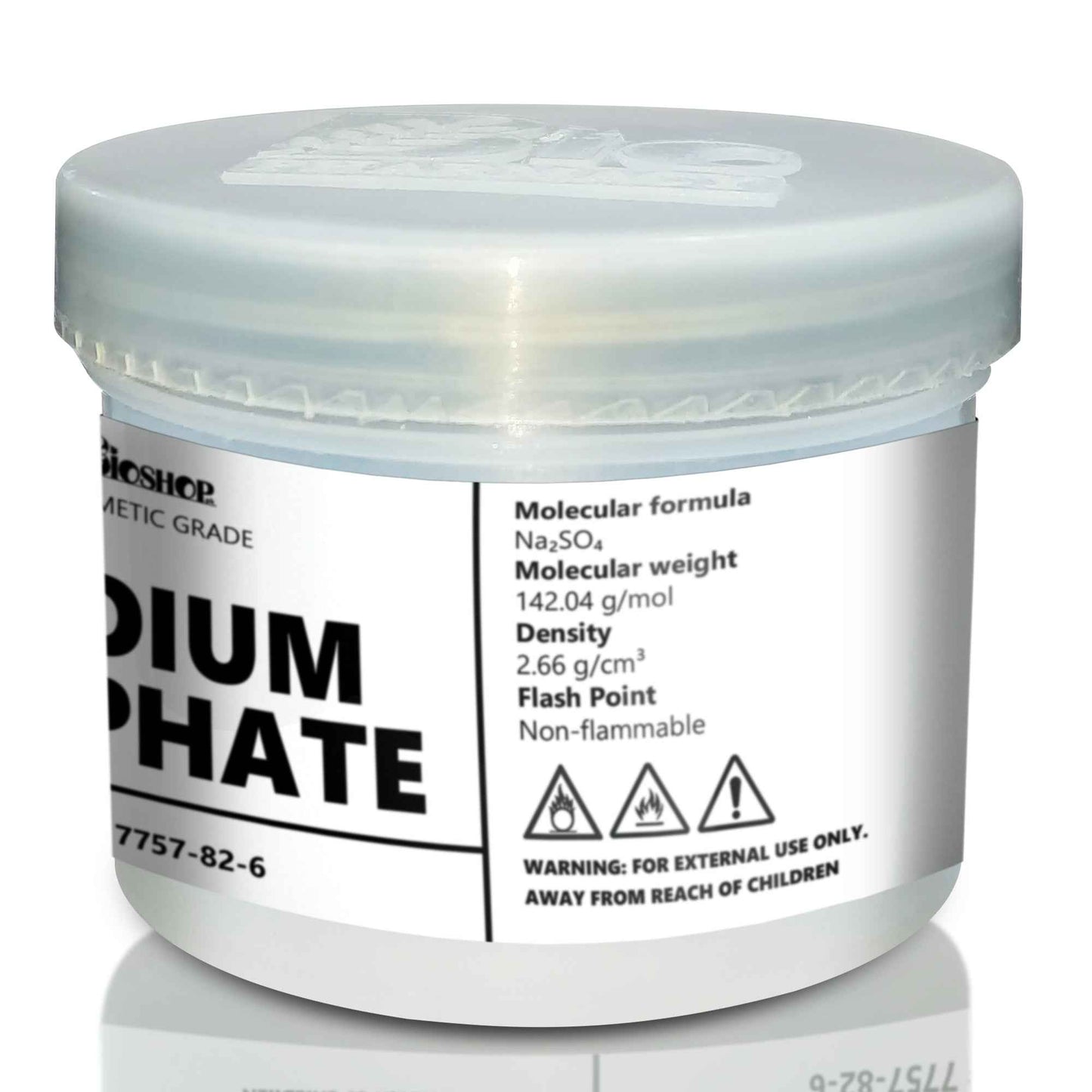
Sodium Sulphate
Sodium Sulphate
Key Functions: Viscosity builder, bath mineral, cleansing matrix support, and opacity aid.
Couldn't load pickup availability


Explore
Information About Sodium Sulphate
✅ Key Features
✦ Builds viscosity in anionic surfactant systems for thicker, more luxurious shampoos and body washes.
✦ Mineral-enriching agent in bath soaks and bath salt blends, contributing a clean and refreshing rinse-off feel.
✦ Water-softening effect in bath formulations makes it a functional additive for spa-inspired products.
✦ Freely soluble in water, enabling clean and straightforward incorporation into aqueous phases.
✦ Compatible with a wide range of surfactant, salt, and humectant systems without destabilising emulsions.
✦ Non-allergenic at cosmetic use levels; approved for use under EU Cosmetics Regulation without restriction.
✦ Inorganic, vegan-compatible, and derived from natural mineral sources — cost-effective and widely available.
🔬 Description
Sodium Sulphate is an inorganic sodium salt of sulfuric acid occurring naturally as the mineral thenardite in its anhydrous form and as mirabilite in its decahydrate form, historically known as Glauber's salt after the 17th-century German-Dutch chemist Johann Rudolf Glauber who first isolated it. While its industrial application in detergents and glass manufacturing spans centuries, its cosmetic role as a functional additive has made it a staple in bath mineral blends, foaming cleansers, and surfactant-based hair care formulations.
What makes Sodium Sulphate particularly useful in cosmetic formulation is its dual action as both a texture modifier and a mineral contributor. In surfactant systems, it interacts with micelle structures to increase the apparent viscosity of aqueous formulations — a mechanism similar to the well-known salt curve effect observed with Sodium Chloride, but with a softer and more controllable thickening response. In bath products, its mineral content contributes to the ionic richness of soaking water, supporting the therapeutic and sensory profile of spa-grade formulations.
Bio Shop Pakistan supplies cosmetic-grade Sodium Sulphate suitable for DIY formulators, independent beauty brands, soap makers, and professional cosmetic chemists.
📊 Technical Data
INCI Name : Sodium Sulfate
Chemical Name : Disodium Sulfate
CAS Number : 7757-82-6
Molecular Formula : Na2SO4
Appearance : White crystalline powder or fine free-flowing granules
Odor : Odorless
pH (1% solution) : 6.5 – 8.0
Solubility : Freely soluble in water; insoluble in ethanol
Specific Gravity : 2.66 (anhydrous)
Flash Point : Not Applicable — non-flammable inorganic salt
HLB Value : Not Applicable
Recommended Use Level : 0.5 – 3% in shampoos and cleansers; 5 – 15% in bath soaks and salt blends
Type : Inorganic salt — viscosity modifier, bath mineral, cleansing matrix support
Shelf Life : 3 years minimum when stored sealed in dry conditions
🧪 Recommended Usage
Skincare (Creams, Serums, Lotions) ★★☆☆☆
Sodium Sulphate has minimal active benefit in leave-on skincare and is not a standard ingredient in serums, creams, or lotions due to its potential to draw moisture from skin at higher concentrations. If included at all, limit to below 0.5% as a minor formulation support agent and always pair with effective humectants.
Haircare (Shampoo, Conditioner, Masks) ★★★★☆
Sodium Sulphate is well-suited to shampoo systems where it builds viscosity and body within anionic surfactant blends. Use at 1 – 3% in the water phase of SLES or SLS-based shampoos to achieve a thicker, more substantive pour consistency.
Soap Making (Cold Process, Melt and Pour) ★★★☆☆
Sodium Sulphate contributes no saponification value and is not appropriate as a primary ingredient in cold process or melt and pour soap. It is however well-suited to bath salt blends, bath bombs, and mineral soaking formulations where it serves as both a filler and a mineral additive.
Body Care (Scrubs, Butters, Balms) ★★★★☆
Sodium Sulphate performs excellently in bath soaks and exfoliating salt scrub blends, contributing mineral weight and a clean rinse-off skin feel. Blend at 5 – 15% alongside Magnesium Sulphate and Dead Sea Salt for a balanced, multi-mineral body soak base.
Functional Cosmetics (Deodorants, Sunscreen, Baby Care) ★★☆☆☆
Sodium Sulphate has very limited application in functional cosmetic categories and is not recommended for sunscreen, baby care, or targeted treatment products. Occasional use in powder-based deodorant formulations is possible but not an established application.
💡 Pro Tip
When I work with anionic surfactant systems on a tighter budget, Sodium Sulphate is one of the first tools I reach for when the salt curve with Sodium Chloride has already peaked or when I need a softer, more gradual thickening response. Unlike NaCl, which can cause a sharp rise and then a dramatic viscosity collapse, Sodium Sulphate offers a more predictable and controllable thickening behaviour in SLES-dominant systems. For bath mineral blends, I consistently combine it with Magnesium Sulphate and Dead Sea Salt to build a multi-mineral soaking profile that feels both therapeutic and professional — without inflating the formulation cost.
ADVANCED TIP: In surfactant systems based primarily on SLES at 15 – 20% active, run a salt curve trial using Sodium Sulphate at 0.5%, 1.0%, 1.5%, 2.0%, and 2.5% increments. Measure viscosity using a Brookfield viscometer at each step to identify the peak before rheological collapse begins. In standard SLES-CAPB blends, the peak typically falls between 1.0 – 2.0%. Formulate at 80% of that peak concentration for reproducible, commercially stable batches that remain pourable at room and cold temperatures.
👩🔬 Skin Type Suitability
Normal Skin : ★★★☆☆ — Tolerated without issue in rinse-off applications; no leave-on benefit.
Dry Skin : ★★☆☆☆ — Hygroscopic nature may exacerbate dryness; avoid in leave-on products for dry skin types.
Oily Skin : ★★★★☆ — Well-suited to clarifying shampoos and foaming cleansers targeting excess sebum.
Combination : ★★★☆☆ — Acceptable in rinse-off formulations; always balance with hydrating co-ingredients.
Sensitive Skin : ★★☆☆☆ — Possible mild irritation at higher concentrations; keep to minimum effective levels in all formulations.
Mature Skin : ★★☆☆☆ — Not recommended for mature skin leave-on products due to potential moisture disruption.
Acne-Prone : ★★★☆☆ — Useful in clarifying cleansers at low working levels; avoid in targeted acne treatment leave-on formulations.
🧴 Formulation Ideas
CONCEPT 1: Detox Multi-Mineral Bath Soak
Usage Level : 10%
Key Ingredients: Magnesium Sulphate, Dead Sea Salt, Lavender Essential Oil, Citric Acid
Result : A mineral-rich bath soak that softens water, promotes relaxation, and leaves skin feeling refreshed and smooth after rinsing.
CONCEPT 2: Clarifying Scalp Shampoo
Usage Level : 2%
Key Ingredients: SLES, Cocamidopropyl Betaine, Panthenol, Peppermint Essential Oil
Result : A thick, high-foaming clarifying shampoo that removes oily scalp buildup while maintaining a comfortable post-wash feel.
CONCEPT 3: Foaming Daily Body Wash
Usage Level : 1.5%
Key Ingredients: SLES, SLS, Cocamide DEA, Glycerin, Fragrance
Result : A viscous, lathering body wash with smooth pour consistency, rich foam, and a clean rinse-off skin feel.
💧 Safety and Regulatory:
NCI Declared : Yes — required on all finished cosmetic products in the EU and under applicable labelling regulations
EU Cosmetics Reg : Permitted — not listed in Annexes I through VI; freely permitted as a cosmetic ingredient
Rinse-Off Limit : No formal maximum established; typically used at 0.5 – 5% in cleansing formulations
Leave-On Limit : Not recommended above 1% in leave-on products; no formal regulatory limit established
Allergen Alert : No — not a recognised cosmetic allergen under EU Cosmetics Regulation
Skin Safety : Safe at recommended levels in rinse-off formulations; avoid prolonged undiluted skin contact
Eye Area Use : Use with caution — avoid direct contact; not recommended in eye care or periocular products
Ingestion : Not for internal use
Pregnancy Use : Consult physician before use in concentrated therapeutic bath formulations
Child Safety : Use diluted; avoid for children under three years without paediatric review
Ventilation : Not required under standard formulation or handling conditions
Storage : Cool, dry place in a sealed container away from humidity and moisture
Container : HDPE sealed bags or containers; avoid open-air storage to prevent hygroscopic caking
⚠️ Sodium Sulphate is hygroscopic — prolonged exposure to air and humidity causes significant caking and clumping. Seal containers immediately after each use and store in low-humidity conditions. At higher concentrations in rinse-off formulations, it may contribute to skin dryness or mild irritation in sensitive individuals; always formulate at the minimum effective level and evaluate finished product irritation potential through appropriate testing.
Stability and Compatibility
Working pH Range : 5.0 – 9.0
Heat Stability : Highly stable; does not degrade under standard cosmetic processing temperatures up to 90°C
Freeze-Thaw Stable : Yes
Emulsion Type : Not applicable — water-soluble inorganic salt; not an emulsifier
Emulsification Phase: Dissolve fully in water phase before combining with other phases; compatible with both hot and cold processing
Compatible With : Anionic surfactants (SLES, SLS), nonionic surfactants (Polysorbate 20/80), bath salts (Magnesium Sulphate, Dead Sea Salt), humectants (Glycerin, Propylene Glycol), and most standard preservative systems
Incompatible With : Concentrated strong acids (risk of sulfuric acid generation at extreme pH); avoid direct co-processing with highly reactive concentrated cationic ingredients
Oxidation Risk : Low — no antioxidant system required
Discoloration Risk : None under normal storage and formulation conditions
Formulation Notes : Always dissolve Sodium Sulphate fully in the water phase before incorporating surfactant concentrates or other salts. In dry bath mineral blends, ensure uniform particle size compatibility with co-salts to prevent granule segregation during packaging and storage.
❓ FAQs
Q: What does Sodium Sulphate do in a cosmetic formulation?
A: Sodium Sulphate functions primarily as a viscosity modifier in surfactant-based products such as shampoos and body washes, and as a mineral-enriching agent in bath soaks and salt blends. It contributes texture and body to cleansing systems while offering a clean, comfortable rinse-off profile.
Q: Is Sodium Sulphate the same as Epsom Salt?
A: No. Epsom Salt is Magnesium Sulphate (MgSO4), while Sodium Sulphate (Na2SO4) is a chemically distinct mineral salt. Both are used in bath formulations, but Magnesium Sulphate is valued for muscle relaxation and magnesium absorption, while Sodium Sulphate is used primarily for viscosity building and water-softening properties.
Q: Can Sodium Sulphate be used in cold process soap?
A: Sodium Sulphate does not saponify and contributes no lather, hardness, or cleansing benefit in cold process soap formulations. It is not a recommended cold process ingredient, though it performs well in bath bombs, bath salt blends, and mineral soaking products where it acts as a filler and mineral contributor.
Q: At what percentage should I use Sodium Sulphate in a shampoo?
A: In shampoo formulations, Sodium Sulphate is typically effective at 1 – 3% added to the water phase. Conducting a salt curve evaluation at incremental additions within your specific surfactant blend will identify the optimal viscosity peak before thinning occurs.
Q: How does Sodium Sulphate compare to Sodium Chloride as a shampoo thickener?
A: Both are inorganic salts that thicken surfactant systems via the salt curve mechanism, but Sodium Chloride produces a sharper and more dramatic viscosity response with a more defined collapse point. Sodium Sulphate offers a softer, more gradual thickening curve, making it preferable when finer viscosity control is required or when the NaCl salt curve has already been exhausted in a given formulation.
Where Can You Safely Use Sodium Sulphate
Discover how Sodium Sulphate performs across different products — rated for safety, stability, and effectiveness.