Bio Shop
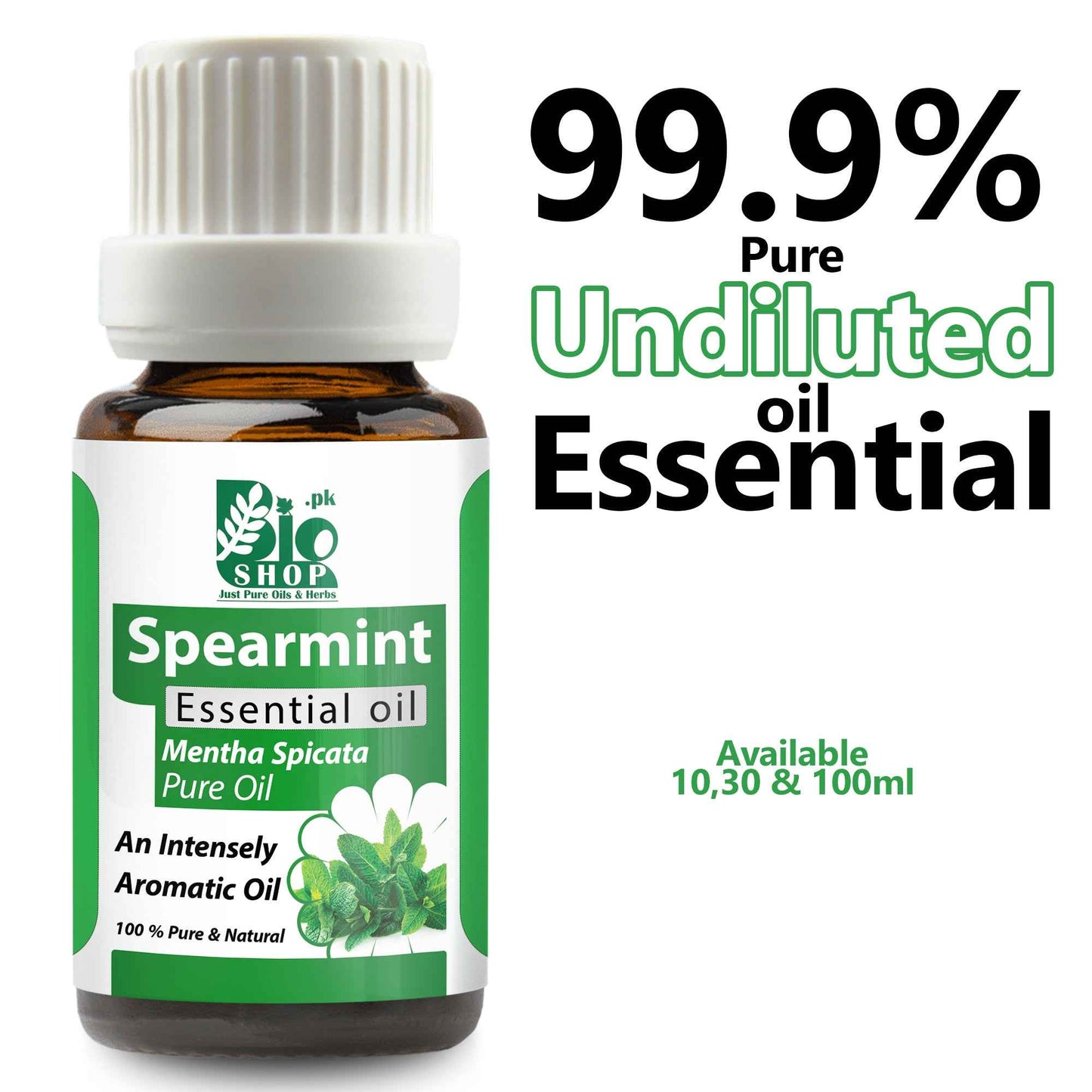
Spearmint Essential Oil
Spearmint Essential Oil
Olfactory Notes: Minty · Fresh · Sweet · Herbal · Cool · Slightly Green
Couldn't load pickup availability


Explore
Information About Spearmint Essential Oil
Key Features
✦ 100% pure steam-distilled Spearmint Essential Oil from Mentha spicata herb
✦ Sweet, cool, and herbaceous minty profile — softer and less intense than peppermint
✦ Dominant compound l-carvone (55–70%) delivers signature fresh spearmint character
✦ Widely used in fine fragrance, shampoos, soaps, oral-care-inspired blends, and candles
✦ Natural top note that lifts and brightens any fragrance composition
✦ Recognised in global fragrance classics and functional personal care formulations
✦ Vegan, cruelty-free, and suitable for DIY and professional cosmetic applications
About Spearmint Essential Oil
Spearmint Essential Oil is obtained by steam distillation of the flowering tops and leaves of Mentha spicata, a perennial herb native to Europe and now cultivated worldwide — with major production in the United States, India, and China. Spearmint has been used for centuries in culinary, medicinal, and aromatic traditions, and its essential oil has been commercially important in the fragrance and flavour industries since the early twentieth century. The oil's distinctive identity is shaped by l-carvone, a ketone that gives spearmint its characteristic sweetness — distinct from the sharper, more menthol-driven profile of peppermint.
What sets spearmint apart in perfumery and cosmetics is its balanced, approachable character. It delivers unmistakable freshness without the aggressive cooling of peppermint or the medicinal bite of eucalyptus. This makes it a preferred choice when formulators need a minty lift that reads as clean and pleasant rather than sharp or clinical. It adapts beautifully across fragrance families — adding brightness to aquatics, lift to herbals, and contrast to orientals and gourmands. Its skin-safe profile at recommended concentrations makes it equally at home in rinse-off and leave-on personal care products.
Bio Shop Pakistan supplies cosmetic-grade Spearmint Essential Oil suitable for DIY perfumers, soap and shampoo formulators, candle makers, and independent beauty crafters who require a reliable, authentic botanical material with consistent aromatic performance.
Olfactory Profile
SCENT DESCRIPTION : Spearmint Essential Oil opens with a burst of clean, sweet mint — noticeably lighter and more herbaceous than peppermint, with a gentle warmth rather than an icy bite. The heart carries a soft, slightly green and leafy quality underpinned by a subtle fruity-floral sweetness from the carvone. It dries down with a clean herbal trail that feels bright and uplifting without being sharp or medicinal.
NOTE POSITION : Top to Top-Mid
FRAGRANCE FAMILY : Fresh Aromatic · Herbal · Aquatic (supporting)
FACETS : Sweet · Minty · Herbaceous · Green · Cooling
TENACITY : Medium — 2 to 4 hours on skin, longer on fabric and in functional blends
SILLAGE : Medium — projects clearly on initial application, settles into a clean skin-close freshness
FIELD 4 — TECHNICAL SPECIFICATIONS
Chemical Name : Mentha spicata herb oil (l-Carvone-rich spearmint fraction)
CAS Number : 8008-79-5
Synonyms : Spearmint Oil · Garden Mint Oil · Mentha viridis Oil · Curly Mint Oil
Purity : 100% pure natural essential oil (no additives or dilution)
Appearance : Colorless to pale yellow mobile liquid
Odor Threshold : Very low — perceivable at trace concentrations
Solubility : Insoluble in water · Soluble in alcohol, fixed oils, and carrier oils
Specific Gravity : 0.917 – 0.934 at 20°C (verify with supplier CoA)
Flash Point : Approximately 54°C / 130°F (verify with supplier CoA)
Type : Natural — steam-distilled from Mentha spicata herb
Technical Specifications
Chemical Name : Mentha spicata herb oil (l-Carvone-rich spearmint fraction)
CAS Number : 8008-79-5
Synonyms : Spearmint Oil · Garden Mint Oil · Mentha viridis Oil · Curly Mint Oil
Purity : 100% pure natural essential oil (no additives or dilution)
Appearance : Colorless to pale yellow mobile liquid
Odor Threshold : Very low — perceivable at trace concentrations
Solubility : Insoluble in water · Soluble in alcohol, fixed oils, and carrier oils
Specific Gravity : 0.917 – 0.934 at 20°C
Flash Point : Approximately 54°C / 130°F (verify with supplier CoA)
Type : Natural — steam-distilled from Mentha spicata herb
Applications & Usage Guidelines
Fine Fragrance : ★★★★★
Spearmint Essential Oil is a classic top note in aromatic fougères, fresh aquatics, and herbal colognes. It adds natural lift and brightness that synthetic mint molecules cannot fully replicate. It pairs exceptionally well with citrus, lavender, and green notes to create clean, energetic opening accords.
Attar & Oriental Blending : ★★★☆☆
While not a traditional attar material, spearmint brings an interesting counterpoint in oriental and woody compositions — its sweetness can soften heavy resins and balance warm spices. Use at low concentrations (under 3%) as a modifier rather than a leading note to avoid dominating warmer, deeper bases.
Functional Fragrance : ★★★★★
Spearmint is one of the most commercially important materials in personal care fragrance — widely used in shampoos, conditioners, body washes, toothpaste-adjacent blends, and deodorants. Its clean, fresh character communicates hygiene and effectiveness, making it ideal for hair care and skin cleansing product lines.
Cosmetics & Skincare : ★★★★☆
At IFRA-compliant concentrations, spearmint essential oil performs well in leave-on skin products including body lotions, massage oils, and foot care formulations. Its gentle cooling sensation adds a pleasant sensory dimension. Observe IFRA limits carefully, particularly for facial and sensitive-skin products.
Home Fragrance : ★★★★★
Spearmint is highly effective in reed diffusers, wax melts, room sprays, and scented candles. It diffuses cleanly, blends well with eucalyptus, lime, and basil for spa-inspired home accords, and retains good cold throw in wax systems. Its relatively modest flash point should be observed in candle formulation.
IFRA & Usage Rate
RECOMMENDED USAGE RATES
EDP (Eau de Parfum) : 2.0 – 4.0%
EDT (Eau de Toilette) : 3.0 – 6.0%
Body Lotion : 1.0 – 2.0%
Shampoo / Body Wash : 1.0 – 3.0%
Candle : 3.0 – 6.0%
Reed Diffuser : 10.0 – 20.0%
Soap (Cold Process) : 1.5 – 3.0%
IFRA 51ST AMENDMENT LIMITS (Mentha spicata herb oil)
Category 1 (Lip products) : 0.3%
Category 2 (Deodorant / body spray) : 0.7%
Category 3 (Eye area cosmetics) : 0.7%
Category 4 (Fine fragrance) : 2.5%
Category 5a (Body lotion / leave-on) : 2.3%
Category 5b (Face cream) : 2.3%
Category 5c (Hand cream) : 2.3%
Category 7a (Rinse-off hair products) : 2.6%
Category 8 (Decorative cosmetics) : 0.3%
Category 9 (Rinse-off body / soap) : 3.8%
Category 10a (Household / air care) : 4.0%
Category 11a (Fabric softener) : 2.3%
Category 11b (Laundry detergent) : 4.0%
Category 12 (Non-skin-contact products) : No limit specified
⚠️ Spearmint Essential Oil contains l-carvone, limonene, and other potential sensitisers. Always observe IFRA 51st Amendment limits by application category.
⚠️ Perform a patch test before use in leave-on skin formulations.
⚠️ Verify exact limits at ifrafragrance.org using the current amendment documentation before commercial production.
Blending Guide
USAGE METHOD 1 — DIRECT INCORPORATION
Add spearmint essential oil directly into your fragrance base, carrier oil, or unscented product base. For perfume blending, dissolve in cosmetic-grade ethanol first, then allow at least 48 hours maceration before evaluating the final scent. This is the standard method for fine fragrance and personal care applications.
USAGE METHOD 2 — PRE-BLEND WITH CITRUS
Spearmint integrates exceptionally well when pre-blended with lemon, bergamot, or lime oil before adding to a composition. Combine spearmint with your chosen citrus at a 1:2 or 1:3 ratio and treat this as a single fresh-accord module. This prevents the spearmint from dominating and creates a more rounded, natural-smelling opening.
USAGE METHOD 3 — TRACE MODIFIER IN COMPLEX BLENDS
At 0.5 to 1.5%, spearmint can function as an invisible freshening agent — a technique borrowed from fine fragrance formulation. It does not read as overtly minty at these concentrations but lifts the overall accord and prevents flat or stale top notes. Particularly effective in floral, aquatic, and fougère bases.
Perfumer's Note
Spearmint is one of those materials I return to constantly — not as a star, but as a reliable architect of freshness. Its l-carvone fraction carries a natural sweetness that no synthetic mint isolate quite captures. In modern aromatic fougères, it works harder than its modest concentration suggests, keeping the top alive while lavender and coumarin carry the heart and base. The real art with spearmint is restraint — push it past 4 or 5 percent in a skin fragrance and it reads as toothpaste; keep it measured and it reads as expensive.
ADVANCED TIP: In soap and shampoo formulations, spearmint essential oil tends to fade faster than expected due to heat and high-pH environments. To extend retention in cold-process soap, encapsulate 30 to 40% of your spearmint dose with a fragrance fixative such as Iso E Super or a musk base before adding to the soap batter. This slows volatilization and ensures the mint character survives the saponification process with better longevity in the finished bar.
Safety & Storage
Physical State : Colorless to pale yellow mobile liquid
Skin Safety : Safe at IFRA-compliant levels; potential sensitiser at high doses — always patch test
Eye Contact : Avoid direct contact; rinse thoroughly with clean water if contact occurs
Ingestion : Not for internal consumption; keep away from children
Ventilation : Use in a well-ventilated workspace; avoid prolonged inhalation of undiluted vapour
Storage : Store in a cool, dark place away from heat, light, and moisture
Shelf Life : 2 to 3 years when stored correctly; l-carvone can oxidise — monitor for off-notes
Container : Amber glass bottle with airtight closure; avoid plastic storage long-term
Flammability : Combustible — keep away from open flame; flash point approximately 54°C
FAQ
Q: What is the difference between spearmint and peppermint essential oil?
A: Spearmint is sweeter and softer — its dominant compound is l-carvone, not menthol. Peppermint has a sharper, more intense cooling sensation due to high menthol content. Spearmint is generally preferred in perfumery for a more rounded, pleasant freshness.
Q: Can I use spearmint essential oil directly on my skin?
A: No — always dilute before skin application. At recommended concentrations in a carrier oil or lotion base, it is considered safe for most users. Always patch test first and observe IFRA limits for your specific product category.
Q: Is spearmint essential oil suitable for cold-process soap?
A: Yes, and it performs reasonably well at 1.5 to 3.0%. Some acceleration of trace is possible at higher doses. Pre-blending with a fixative or using it with a small amount of fragrance anchor can improve scent retention through the saponification process.
Q: Will spearmint essential oil hold its scent in soy candles?
A: It performs adequately at 4 to 6% in soy wax, though it is a volatile top note and will diminish over time in the jar. Blending it with mid and base note materials — such as cedarwood or vetiver — improves overall fragrance longevity and throw in candle applications.
Q: How does spearmint essential oil compare to synthetic carvone or spearmint fragrance oil?
A: Pure l-carvone isolate is sharper and more linear — it delivers the defining spearmint note without the herbaceous, green complexity of the full essential oil. Synthetic spearmint fragrance oils are more consistent in performance but lack the natural nuance. For natural and botanical-branded formulations, the essential oil is the correct choice; for cost efficiency and high-volume functional fragrance, synthetic options offer better stability and value.
Where Can You Safely Use Spearmint Essential Oil?
Discover how Spearmint Essential Oil performs across different applications—rated for safety, stability, and effectiveness.
There service is so good.and authentic products