


Bio Shop
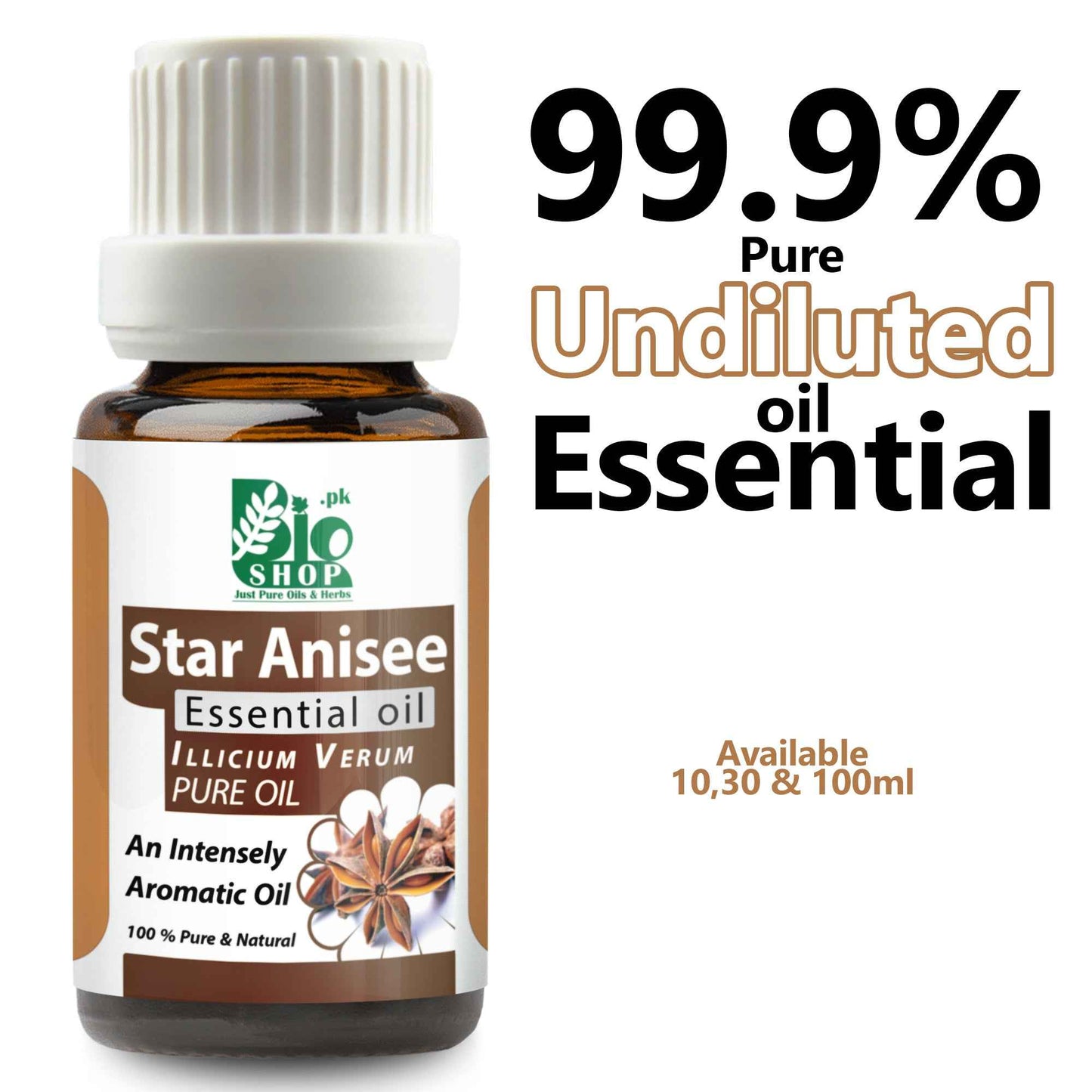
Star Anise Essential Oil
Star Anise Essential Oil
Olfactory Notes: Anise · Sweet · Spicy · Licorice-like · Warm · Aromatic
Couldn't load pickup availability


Explore
Information About Star Anise Essential Oil
Key Features
✦ Pure steam-distilled essential oil from Illicium verum dried star-shaped fruits
✦ Dominant trans-anethole content (80–90%) delivers an intense sweet licorice and spicy character
✦ Versatile in fine fragrance, oriental attars, candles, soaps, and functional personal care
✦ Naturally crystallizes at cool temperatures due to high anethole content — gently warm before use
✦ Key ingredient in iconic oriental and gourmand fragrance accords, masala attars, and chai-inspired blends
✦ 100% natural, plant-derived, vegan and cruelty-free
✦ IFRA-regulated due to sensitization potential of trans-anethole — always observe recommended usage limits
About Star Anise Essential Oil
Star Anise Essential Oil is extracted by steam distillation of the dried fruits of Illicium verum Hook. f., a small evergreen tree cultivated predominantly in Guangxi province of China and in northern Vietnam. The distinctive star-shaped fruit has been used for over two thousand years in Chinese and Vietnamese medicine, culinary traditions, and ceremonial incense. The oil became commercially significant in European perfumery during the 19th century and remains a foundational material in oriental, gourmand, and spice-forward fragrance categories to this day.
What sets star anise essential oil apart from other spice oils is the remarkable dominance of trans-anethole, which typically constitutes 80 to 90 percent of the oil's composition. This single compound is responsible for the oil's unmistakable sweet, candy-like licorice scent with warm anisic and slightly phenolic undertones. Unlike anise seed oil, which is sourced from Pimpinella anisum and shares a similar aroma, star anise oil tends to be slightly richer and more tenacious, making it more suitable for heavy perfumery bases and incense applications. The oil is also a natural source of anethole used in flavoring and pharmaceutical preparation.
Bio Shop Pakistan supplies cosmetic-grade star anise essential oil suitable for DIY perfumers, attar and mukhallat blenders, soap and candle makers, and independent cosmetic formulators seeking authentic natural spice ingredients for their creations.
Olfactory Profile
SCENT DESCRIPTION : Star Anise Essential Oil opens with a bold, sweet, licorice-candy burst that is simultaneously warm and slightly medicinal. The heart reveals a spiced anisic depth with soft phenolic nuances and a faintly herbaceous undertone. As it dries down it leaves a smooth, balsamic-sweet trail with gentle woody warmth. The overall impression is of a confectionery spice market — deeply familiar, comforting, and surprisingly complex.
NOTE POSITION : Top to Middle
FRAGRANCE FAMILY : Oriental / Spicy / Gourmand
FACETS : Sweet · Licorice · Anisic · Warm Spice · Balsamic
TENACITY : High — projects well for 6 to 10 hours in alcohol-based formulations; longer in wax and resin-based media
SILLAGE : High — diffuses intensely in the opening; settles to a moderate, close-to-skin warmth in the dry-down
Technical Specifications
CHEMICAL NAME : Trans-Anethole-rich essential oil from Illicium verum Hook. f. fruit
CAS NUMBER : 8007-70-3
SYNONYMS : Chinese Anise Oil, Illicium Oil, Anise Star Oil, Badyan Oil
PURITY : 100% pure essential oil (no additives or carriers) — verify with CoA
APPEARANCE : Colorless to pale yellow mobile liquid; may partially solidify below 15°C due to anethole crystallization
ODOR THRESHOLD : Extremely low — detectable at trace concentrations; use with precision
SOLUBILITY : Freely soluble in ethanol and fixed oils; practically insoluble in water
SPECIFIC GRAVITY : 0.978 – 0.990 at 20°C (verify with supplier CoA)
FLASH POINT : Approximately 70°C / 158°F (verify with supplier CoA)
TYPE : Natural essential oil — steam distilled
Applications & Usage Guidelines
Fine Fragrance : ★★★★★
Star anise essential oil is a cornerstone spice note in oriental, gourmand, and Middle Eastern-inspired fine fragrances. It contributes the sweet licorice heart of many iconic mukhallat and eau de parfum accords. Use with restraint — it can dominate a blend at concentrations above 2%.
Attar & Oriental Blending : ★★★★★
In Pakistani and Gulf-style attar making, star anise is indispensable. It pairs powerfully with oud, sandalwood, amber, and rose absolutes to create deep masala attars and chai-inspired compositions. It is among the most-used spice oils in traditional oriental perfumery in South Asia.
Functional Fragrance : ★★★☆☆
Star anise works well in shampoos, body washes, and shower gels where its medicinal-spice character adds freshness and a distinctive signature. Stability in surfactant systems is generally good. Observe IFRA rinse-off limits and conduct patch testing for leave-on products.
Cosmetics : ★★★☆☆
Useful in massage oils, body scrubs, and foot care products where its warming and mildly antimicrobial properties add functional value. Leave-on applications require strict adherence to IFRA limits due to anethole sensitization potential. Not recommended for lip products above 0.08%.
Home Fragrance : ★★★★★
Exceptional performance in reed diffusers, candles, incense sticks, and room sprays. Star anise creates warm, spicy oriental ambiance with outstanding throw. It is a key note in bakery, chai, and festive seasonal home fragrance accords.
IFRA & Usage Rate
RECOMMENDED USAGE RATES
EDP (Eau de Parfum) : 0.5 – 1.0%
EDT (Eau de Toilette) : 0.3 – 0.8%
Body Lotion : 0.1 – 0.2%
Shampoo / Body Wash : 0.2 – 0.5%
Bar Soap : 0.3 – 0.6%
Candle (Wax) : 1.0 – 3.0%
Reed Diffuser : 5.0 – 15.0%
IFRA 51ST AMENDMENT LIMITS (Illicium verum Fruit Oil)
Category 1 (Lip products) : 0.08% maximum
Category 2 (Deodorant / Underarm spray) : 0.08% maximum
Category 3 (Eye area cosmetics) : 0.08% maximum
Category 4 (Fine fragrance) : 1.0% maximum
Category 5 (Face moisturizer / leave-on) : 0.2% maximum
Category 7 (Rinse-off products) : 0.6% maximum
Category 8 (Shampoo / shower gel) : 0.6% maximum
Category 9 (Hand and body lotion) : 0.2% maximum
Category 11 (Toilet / bar soap) : 0.6% maximum
Category 12 (Candles / non-skin contact) : No IFRA restriction
⚠ Trans-anethole is a documented skin sensitizer. Exceeding IFRA limits significantly increases the risk of allergic contact dermatitis, especially in leave-on rinse-off formulations.
⚠ Always verify current IFRA 51st Amendment limits at ifrafragrance.org before formulating for retail sale.
⚠ EU Cosmetics Regulation requires labeling of anethole as an allergenic material when present above declarable thresholds in leave-on products.
Blending Guide
USAGE METHODS
Method 1 — Dilute in Carrier First
Star anise essential oil is very potent. Always pre-dilute in a carrier oil, DPG, or IPM at 10–20% before incorporating into your final formula. This prevents overdosing and ensures even distribution throughout the blend.
Method 2 — Build the Accord Layer by Layer
Add star anise to your spice-oriental base first alongside cinnamon, clove, or cardamom. Allow this spice accord to blend for 24 hours before introducing floral and woody modifiers. This prevents the anisic note from overpowering lighter materials.
Method 3 — Wax Blending for Candles and Incense
In candle making, add star anise oil to the melted wax at 65–70°C just before pouring. For incense sticks, blend with a DPG and ethanol carrier mixture first to ensure even absorption into the bamboo base. Avoid overheating as it may cause top-note flash-off.
BEST PAIRINGS
Oud (natural or synthetic) → Deepens the oriental base and adds smoky-resinous contrast
Vanilla / Ethyl Vanillin → Creates a classic sweet oriental gourmand accord
Rose Absolute / Rose Otto → Lifts the blend with floral contrast against the spice
Cinnamon Bark or Leaf Oil → Builds a warm masala-spice heart ideal for attar blending
Cardamom Essential Oil → Adds green-spicy complexity and a chai-inspired freshness
Sandalwood (Mysore type) → Smooth creamy base that anchors the anisic volatility
Benzoin Resinoid → Adds sweet balsamic fixation and improves longevity
Black Pepper Essential Oil → Introduces dry, peppery contrast to the sweetness
AVOID
✦ Avoid combining with green or fresh aquatic materials — the sweet licorice character clashes with marine-ozonic notes
✦ Do not use undiluted directly on skin under any circumstances
✦ Avoid high-heat environments above 80°C in wax formulations to prevent anethole degradation
Perfumer's Note
When I work with star anise essential oil, I think of it as one of the most democratically powerful spice materials available to any formulator — it punches far above its price point and volume. A single drop can reorient an entire composition toward the warm, comforting territory of an oriental bazaar. The challenge is never about what it can do, but about teaching yourself restraint. The anethole that gives it that irresistible licorice-candy signature is also what makes it bossy in a blend — it will climb over rose, overwhelm musk, and eat your floral heart alive if you let it. The formulators who use it best treat it not as a featured note but as a hidden warmth underneath — a sweetness that makes people lean in and wonder what the scent is without being able to name it.
ADVANCED TIP
Try building a small anise-vanillin pre-mix using 1 part star anise essential oil, 3 parts ethyl vanillin 10% solution in DPG, and 1 part benzyl benzoate as a fixative carrier. Let this micro-accord mature for 48 hours before adding it to your oriental base at 0.5–1.0% of your total formula. This technique rounds the sharp medicinal edge of the trans-anethole and integrates it seamlessly into the body of your composition, making it smell like a naturally faceted ingredient rather than a single spice chemical.
Safety & Storage
PHYSICAL STATE : Liquid at room temperature; may solidify partially below 15°C — gently warm in warm water before use
SKIN SAFETY : Dilute properly before all skin contact; documented sensitizer at high concentrations; always respect IFRA limits
EYE CONTACT : Avoid all contact with eyes; rinse thoroughly with water and seek medical advice if contact occurs
INGESTION : Not for internal use; this is a cosmetic-grade ingredient — keep out of reach of children
VENTILATION : Work in a well-ventilated space; inhalation of concentrated vapor may cause irritation in sensitive individuals
STORAGE : Store in a tightly sealed dark glass or HDPE container away from heat, light, and moisture
SHELF LIFE : 2 to 3 years from production date when stored correctly; anethole content may crystallize over time without affecting quality
CONTAINER : Amber glass or HDPE plastic — avoid PET; do not store in copper or iron vessels
FLAMMABILITY : Combustible — flash point approximately 70°C; keep away from open flames and ignition sources
FAQ
Q: Can I use star anise essential oil directly on skin without diluting?
A: No. Always dilute to a safe usage level in a carrier oil or formulation base before skin contact. Undiluted application can cause sensitization or irritation due to the high trans-anethole content.
Q: My star anise oil has turned cloudy or semi-solid. Is it still good?
A: Yes. This is completely normal. Trans-anethole crystallizes below approximately 15 to 20°C. Simply place the sealed bottle in warm water for a few minutes and the oil will return to its clear liquid state. Quality is unaffected.
Q: What is the difference between star anise essential oil and anise seed oil?
A: Both contain trans-anethole as the dominant component and share a similar licorice character. Star anise (Illicium verum) tends to be slightly richer and more tenacious with a deeper, somewhat more balsamic dry-down. Anise seed oil (Pimpinella anisum) is lighter and more herbal-bright. In perfumery, both are largely interchangeable but star anise performs better in oriental and heavy bases.
Q: Is star anise essential oil safe to use in candles?
A: Yes. There are no IFRA restrictions for non-skin-contact applications like candles. Use at 1 to 3% in wax for good room throw. Add to the wax at 65 to 70°C just before pouring to preserve the top-note character.
Q: Is star anise essential oil suitable for attar and mukhallat blending?
A: Absolutely — it is one of the most traditional and beloved spice materials in South Asian and Gulf-style attar making. Combine it with oud, sandalwood, rose, and amber bases at 0.5 to 1.0% of the total formula to add warm, sweet-spicy depth without overpowering the composition.
Where Can You Safely Use Star Anise Essential Oil?
Discover how Star Anise Essential Oil performs across different applications—rated for safety, stability, and effectiveness.


