

Bio Shop
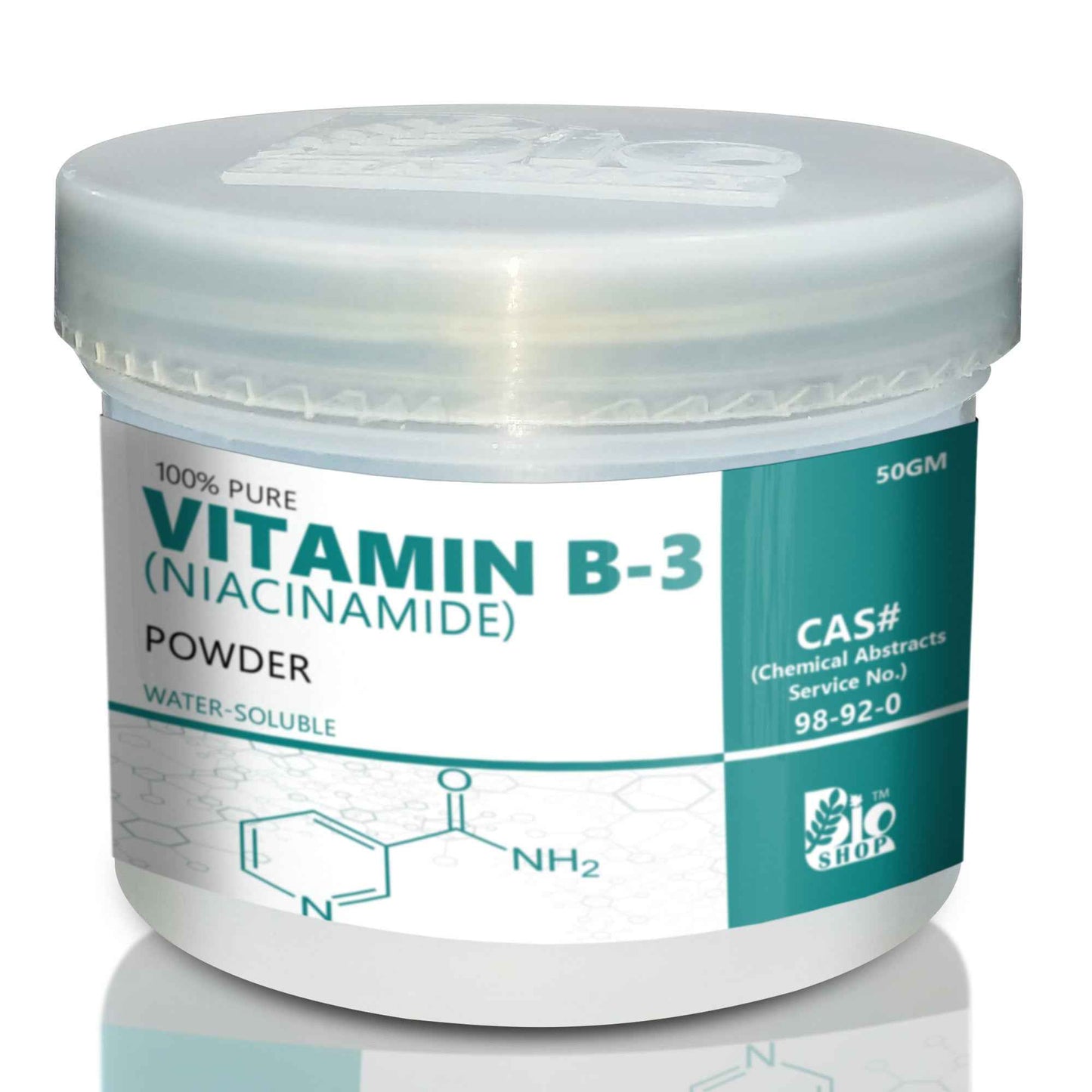
Vitamin B3 (Niacinamide)
Vitamin B3 (Niacinamide)
Key Functions: Brightens skin tone, minimizes pores, and reduces acne and redness by improving the skin barrier and regulating sebum.
Couldn't load pickup availability
Explore
Information About Vitamin B3 (Niacinamide)
✅ Key Features
✦ Clinically proven water-soluble Vitamin B3 active that brightens, refines pores, and reduces dark spots at 5% use level.
✦ Inhibits melanosome transfer to keratinocytes, directly reducing hyperpigmentation and uneven skin tone over consistent use.
✦ Regulates sebaceous activity and minimizes the visible appearance of enlarged pores in oily and combination skin types.
✦ Boosts ceramide and fatty acid synthesis in the skin barrier, improving moisture retention and reducing transepidermal water loss.
✦ Anti-inflammatory properties reduce redness, calm acne-related irritation, and fade post-inflammatory hyperpigmentation effectively.
✦ Compatible with a wide range of cosmetic actives, emulsifiers, and formulation systems at 2–10% use level.
✦ Vegan, non-animal-derived, and suitable for all skin types including sensitive, mature, oily, and acne-prone skin.
🔬 Description
Niacinamide is the cosmetically active amide form of Vitamin B3, also known by the synonym nicotinamide, with a history rooted in nutritional biochemistry and clinical dermatology. Its INCI name is Niacinamide, and it has been studied in dermatological applications since the 1970s. The transition into mainstream cosmetic formulation accelerated in the late 1990s as independent studies confirmed measurable improvements in skin tone, barrier integrity, and sebum control at concentrations of 2–5%, making it one of the most well-documented actives available to formulators today.
What distinguishes Niacinamide from most other brightening agents is the breadth of its mechanism. It operates through several independent biological pathways simultaneously — suppressing melanosome transfer, upregulating ceramide synthesis, modulating inflammatory cytokine expression, and reducing sebaceous activity. This multifunctional action allows a single ingredient to address pigmentation, aging, acne, and sensitivity within one formulation without the irritation risks associated with retinoids or high-concentration acids.
Bio Shop Pakistan supplies cosmetic-grade Niacinamide suitable for DIY skincare enthusiasts, professional cosmetic formulators, and beauty brands developing brightening serums, anti-aging moisturizers, and pore-refining toners across Pakistan.
📊 Technical Data
INCI Name : Niacinamide
Chemical Name : Pyridine-3-carboxamide (Nicotinamide)
CAS Number : 98-92-0
Molecular Formula : C6H6N2O
Appearance : White crystalline powder
Odor : Odorless to faintly characteristic
pH (1% solution) : 6.0 – 7.5
Solubility : Freely soluble in water; slightly soluble in ethanol; practically insoluble in fixed oils
Specific Gravity : Approx. 1.40 g/cm³ (true particle density; bulk density varies by grade)
Flash Point : Not Applicable (non-combustible solid)
HLB Value : Not Applicable
Recommended Use Level : 2% – 10% (5% most commonly used for balanced efficacy and tolerance)
Type : Water-soluble cosmetic active / Vitamin B3 derivative
Shelf Life : 2–3 years when stored in a cool, dry place away from moisture and light
🧪 Recommended Usage
Skincare (Creams, Serums, Lotions) ★★★★★
Niacinamide is one of the most effective and versatile actives for leave-on skincare formulations, delivering brightening, anti-aging, barrier-repair, and pore-refining benefits across product types. Use at 5% for general serums and moisturizers, or up to 10% in targeted hyperpigmentation treatments.
Haircare (Shampoo, Conditioner, Masks) ★★★☆☆
Niacinamide provides scalp barrier support and mild conditioning benefit when used in shampoos and scalp serums at 1–3%. Its efficacy in haircare is supportive rather than primary and works best as a complement to dedicated hair actives.
Soap Making (Cold Process, Melt and Pour) ★★☆☆☆
Niacinamide does not survive the high-pH saponification process of cold process soap and is not recommended for that application. In melt and pour bases, it may be added at trace at 1–2%, though skin-level efficacy is limited due to brief contact time.
Body Care (Scrubs, Butters, Balms) ★★★☆☆
Niacinamide is effective in water-based body lotions and body serums at 2–5% for tone-evening and barrier support on the body. It is not suitable for fully anhydrous systems such as body butters or balms due to its water-only solubility.
Functional Cosmetics (Deodorants, Sunscreen, Baby Care) ★★★★☆
Niacinamide is a documented addition to sunscreen emulsions where it enhances photoprotection and addresses UV-induced pigmentation at 2–5%. It is also used in deodorants for its anti-inflammatory and skin tone benefits on underarm skin.
💡 Pro Tip
When I formulate with Niacinamide, I treat it as a true workhorse active — one that gives consistent, measurable results without demanding complicated formulation accommodations. I always dissolve it directly in the water phase during the heating stage, which ensures full integration and leaves no undissolved residue in the finished formula. The most important variable I control is pH. I keep every Niacinamide-containing formulation between pH 5.5 and 7.0 without exception. Below that range, particularly under 4.0, Niacinamide hydrolyzes to nicotinic acid, which is the compound responsible for the niacin flush reaction — temporary redness and tingling that some consumers misinterpret as sensitivity to Niacinamide itself. I also avoid combining Niacinamide at high concentrations in the same product as L-Ascorbic Acid in a low-pH formulation, not because they are chemically antagonistic, but because the acidic environment needed for Vitamin C stability drives the conversion I want to avoid.
ADVANCED TIP: For a high-performance triple-brightening serum, combine 5% Niacinamide with 2% Alpha Arbutin and 1% Tranexamic Acid in a water-based gel at pH 6.0–6.5. Dissolve the Niacinamide in your water phase at 70–75°C, cool the batch below 40°C, then introduce Alpha Arbutin and Tranexamic Acid with gentle stirring to preserve activity. This combination attacks melanogenesis at three independent checkpoints — melanosome transfer inhibition, tyrosinase inhibition, and plasminogen pathway suppression — producing a synergistic brightening result that surpasses any single active used alone at the same total percentage.
👩🔬 Skin Type Suitability
Normal Skin : ★★★★★ — Universally well-tolerated with no contraindications; delivers brightening, pore refinement, and barrier support without any drawbacks.
Dry Skin : ★★★★☆ — Enhances ceramide synthesis and reduces transepidermal water loss, but must be paired with humectants and emollients for complete dry skin relief.
Oily Skin : ★★★★★ — Ideal for oily skin types due to its clinically documented sebum-regulating and pore-minimizing action at 5%.
Combination : ★★★★☆ — Balances both oily and dry zones effectively, though supporting ingredients addressing the drier areas are needed for optimal results.
Sensitive Skin : ★★★☆☆ — Well-tolerated at 2–4%, but concentrations above 5% may provoke mild transient flushing in a small subset of sensitive individuals if formulation pH is not controlled.
Mature Skin : ★★★★★ — Reduces fine lines, supports collagen-adjacent pathways, and corrects age spots, making it an essential active in anti-aging formulations for mature skin.
Acne-Prone : ★★★★☆ — Anti-inflammatory and sebum-regulating properties make it highly suitable for acne-prone skin; post-inflammatory hyperpigmentation responds well with consistent 5% use.
🧴 Formulation Ideas
CONCEPT 1: Brightening Pore-Refining Serum
Usage Level : 5%
Key Ingredients: Alpha Arbutin 2%, Hyaluronic Acid 1%, Allantoin 0.5%, Panthenol 3%
Result : A lightweight water-based serum that visibly reduces dark spots, minimizes pore appearance, and delivers continuous hydration suitable for daily morning and evening use.
CONCEPT 2: Anti-Aging Barrier Repair Moisturizer
Usage Level : 4%
Key Ingredients: Ceramide NP 1%, Squalane 5%, Shea Butter 8%, Sodium PCA 2%
Result : A rich yet fast-absorbing moisturizer that firms skin, restores the lipid barrier, and fades fine lines and uneven pigmentation over continued daily application.
CONCEPT 3: Oil-Control Clarifying Toner
Usage Level : 3%
Key Ingredients: Zinc PCA 1%, Witch Hazel Extract 5%, Allantoin 0.3%, Glycerin 3%
Result : A refreshing daily toner that controls excess sebum production, visibly tightens enlarged pores, and delivers anti-inflammatory benefits for oily and acne-prone skin.
💧 Safety and Regulatory:
INCI Declared : Yes — required on all finished cosmetic product labels globally
EU Cosmetics Reg : Permitted — not listed in Annexes II, III, IV, or VI of EU Cosmetics Regulation 1223/2009; no concentration restrictions established
Rinse-Off Limit : No established limit; typical use 1–5%
Leave-On Limit : No established limit; typical use 2–10%
Allergen Alert : No — not classified as a known cosmetic allergen
Skin Safety : Safe at recommended levels; concentrations above 10% may cause transient flushing in some individuals when formulation pH is below 5.0
Eye Area Use : Use with caution — keep below 4% in eye area products; avoid direct contact with eyes
Ingestion : Not for internal use
Pregnancy Use : Generally considered safe for topical use at standard cosmetic levels; consult physician for formulations above 5%
Child Safety : Safe for children above 3 years at standard cosmetic levels; dilute appropriately for baby care applications
Ventilation : Not required
Storage : Cool, dry place below 25°C; protect from moisture, humidity, and direct light
Container : HDPE, glass, or PET — keep sealed; avoid prolonged storage in open or humid conditions
⚠️ Warning: At concentrations above 10% or in formulations with pH below 4.0, Niacinamide may hydrolyze to nicotinic acid, causing transient niacin flush (temporary skin redness and tingling). Always formulate within pH 5.0–7.0 and stay within the 2–10% use range for leave-on products to prevent this reaction.
Stability and Compatibility
Working pH Range : 5.0 – 7.0 (optimal stability and bioavailability; avoid below 4.0 for leave-on formulations)
Heat Stability : Stable up to 80°C; recommended to dissolve in water phase at 70–75°C
Freeze-Thaw Stable : Yes
Emulsion Type : O/W and W/O (water-phase soluble only; must be incorporated via the aqueous phase)
Emulsification Phase: Hot or cold — dissolves readily in water at room temperature; heat-dissolving at 70°C recommended for faster, complete integration
Compatible With : Hyaluronic Acid, Allantoin, Panthenol, Ceramides, Zinc PCA, Peptides, Alpha Arbutin, Tranexamic Acid, Azelaic Acid
Incompatible With : High-concentration L-Ascorbic Acid in low-pH (below 3.5) formulations — promotes hydrolysis to nicotinic acid and reduces efficacy of both actives; avoid co-formulation in the same acidic leave-on system without buffering
Oxidation Risk : Low — no antioxidant required; stable in standard aqueous and emulsion systems
Discoloration Risk : Possible — slight yellowing may occur above 85°C during processing or under prolonged high-humidity storage conditions
Formulation Notes : Dissolve Niacinamide completely in the water phase before combining with the oil phase. If using alongside Vitamin C, maintain formulation pH at 5.5–6.5 or apply as separate products to avoid nicotinic acid conversion.
❓ FAQs
Q: What is the ideal usage level for Niacinamide in a leave-on serum?
A: The most effective and well-tolerated concentration for a leave-on serum is 5%. Levels of 2–10% are all supported by clinical data, with 5% offering the best balance between visible results and tolerance across diverse skin types.
Q: Can Niacinamide and Vitamin C be used together in the same formula?
A: Combining high-dose Niacinamide with L-Ascorbic Acid in the same low-pH (below 3.5) formulation is not ideal, as the acidic environment promotes Niacinamide hydrolysis to nicotinic acid, which can reduce the efficacy of both ingredients. The safer approach is to use them in separate products or buffer the combined formulation to pH 5.5–6.5.
Q: Why does Niacinamide sometimes cause skin flushing?
A: Flushing is caused by nicotinic acid, a degradation product that forms when Niacinamide is exposed to very low pH or used above 10% without proper formulation control. Niacinamide itself does not cause flushing. Keeping the formulation at pH 5.5–7.0 and staying within 5–10% use level eliminates this risk entirely.
Q: How do I correctly add Niacinamide to an emulsion?
A: Niacinamide is water-soluble and must always be added to the aqueous (water) phase of your emulsion. It dissolves easily in water at room temperature or can be heat-dissolved at 70–75°C during the hot process phase. Once fully dissolved and the emulsion is formed, Niacinamide remains stable and evenly distributed throughout the finished formula.
Q: How does Niacinamide compare to Alpha Arbutin for skin brightening?
A: Both are effective brightening agents but work through different pathways. Niacinamide inhibits melanosome transfer from melanocytes to skin surface cells, while Alpha Arbutin directly inhibits tyrosinase, the enzyme that drives melanin synthesis upstream. Alpha Arbutin is considered more potent for targeted depigmentation at lower concentrations, while Niacinamide offers the additional benefits of pore refinement, sebum control, and barrier repair that Alpha Arbutin does not provide. Combining both at 5% Niacinamide and 1–2% Alpha Arbutin delivers superior brightening results than either used alone.
Where Can You Safely Use Vitamin B3 (Niacinamide)
Discover how Vitamin B3 (Niacinamide) performs across different products — rated for safety, stability, and effectiveness.
Recommended
.
January se use kar rahi hoon. Melasma 80% improved. Pores smaller. Skin texture smooth. Overall skin health transformed. Bio Shop niacinamide quality hamesha consistent rahi. Saal ka single best skincare investment. Highly recommend to every Pakistani woman.
Apni brightening skincare line mein niacinamide key ingredient hai. Bio Shop reliable supply aur consistent quality ensure karta hai. Customers ke results excellent hain. Professional documentation bhi available hai. Highly recommend for brand formulators.
Lahore ki garmi mein skin bilkul oily nahi hoti jab niacinamide routine mein hai. Sebum production genuinely reduced. Primer ki zaroorat kam ho gayi. Bio Shop niacinamide quality excellent. Pakistani summers mein yeh ingredient zaroori hai.
Shukriya Bilal! Niacinamide for oil control in Pakistan's intense summer heat is a brilliant application - it reduces sebum production at the cellular level so skin stays matte naturally all day!


