Bio Shop
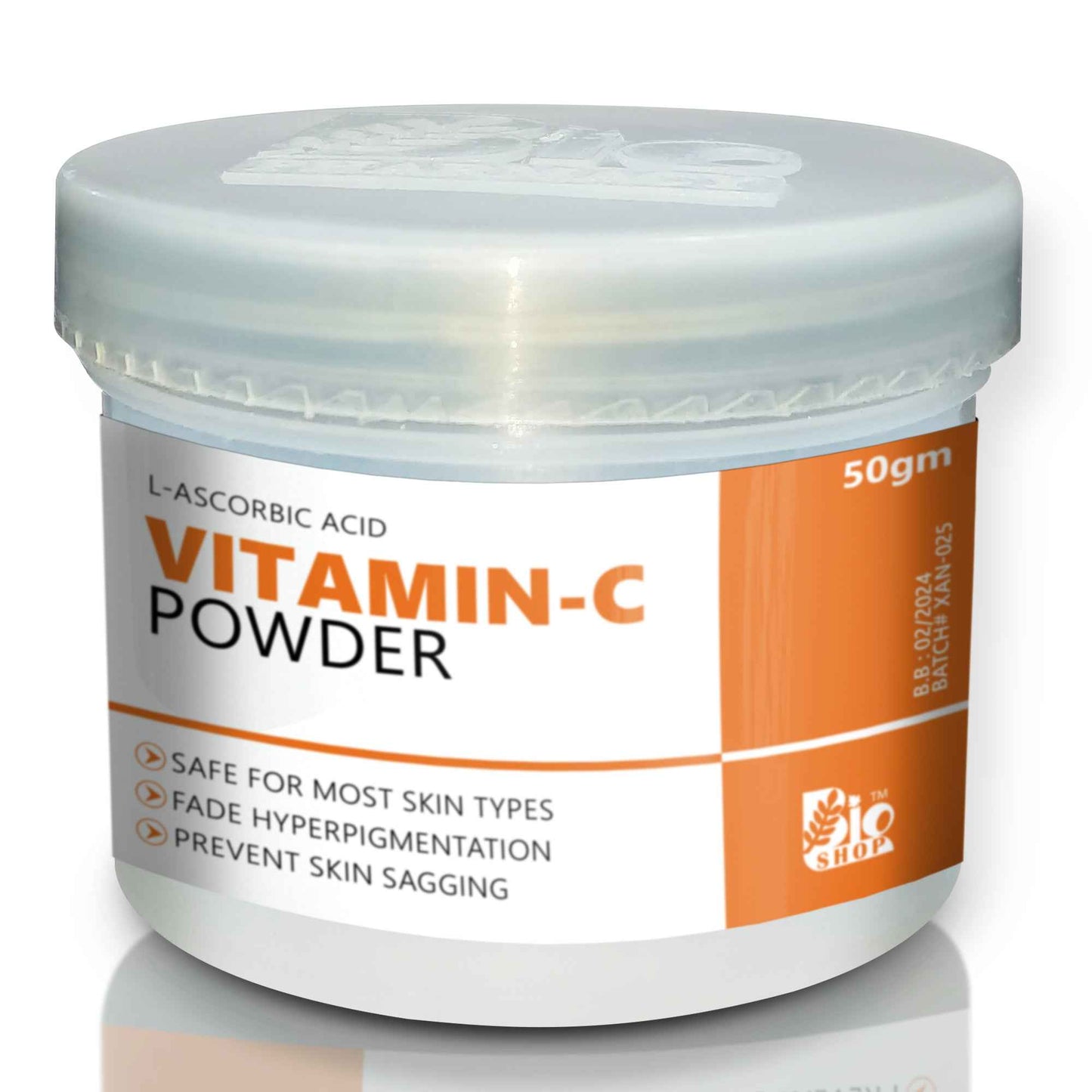
Vitamin C Powder (L-Ascorbic Acid)
Vitamin C Powder (L-Ascorbic Acid)
Key Functions: Brightens, boosts collagen, fades dark spots, and antioxidant protection.
Couldn't load pickup availability
Explore
Information About Vitamin C Powder (L-Ascorbic Acid)
✅ Key Features
✦ Potent antioxidant that neutralizes free radicals and shields skin from UV-induced oxidative stress.
✦ Inhibits tyrosinase activity to visibly fade dark spots, hyperpigmentation, melasma, and post-acne marks.
✦ Stimulates collagen synthesis by supporting hydroxylation of proline and lysine, improving firmness and elasticity.
✦ Water-soluble active ideal for high-performance brightening serums, low-pH tonics, and treatment ampoules.
✦ Vegan, non-animal-derived, and naturally present in many fruits — compatible with clean-label cosmetic formulations.
✦ Works synergistically with ferulic acid and vitamin E to significantly enhance photostability and extend antioxidant efficacy.
✦ Cosmetic-grade purity ensures batch-to-batch potency consistency for professional and advanced DIY formulation work.
🔬 Description
Vitamin C, in its purest cosmetically active form as L-Ascorbic Acid, is a water-soluble vitamin found naturally in citrus fruits, rose hips, and leafy greens. Its role in topical skin care became scientifically prominent in the late twentieth century when research confirmed its dual ability to modulate melanin synthesis and directly support dermal collagen networks. Today it is considered one of the most evidence-backed actives in cosmetic dermatology and is a foundational ingredient in professional brightening formulations worldwide.
What distinguishes L-Ascorbic Acid from all other vitamin C derivatives is that it is the biologically direct form — no skin-level conversion is required. It penetrates the stratum corneum most effectively at a working pH of 2.5 to 3.5, where it delivers antioxidant, tyrosinase-inhibiting, and collagen-stimulating activity simultaneously. At concentrations above 10 percent, published clinical studies report measurable increases in dermal collagen density over 8 to 12 weeks of consistent use, making it a genuine anti-aging active rather than a surface-level cosmetic.
Bio Shop Pakistan supplies cosmetic-grade L-Ascorbic Acid powder suitable for professional skin care formulators, independent beauty brands, DIY beauty makers, and cosmetic science students.
📊 Technical Data
INCI Name : Ascorbic Acid
Chemical Name : (R)-3,4-Dihydroxy-5-((S)-1,2-dihydroxyethyl)furan-2(5H)-one
CAS Number : 50-81-7
Molecular Formula : C6H8O6
Appearance : White to off-white crystalline powder
Odor : Odorless to faintly acidic
pH (1% solution) : 2.2 – 2.6
Solubility : Freely soluble in water; slightly soluble in ethanol; insoluble in fixed oils
Specific Gravity : 1.65 g/cm³ (crystal density); bulk powder density approx. 0.85 g/cm³
Flash Point : Not applicable (non-flammable solid; decomposes above 190°C)
HLB Value : Not applicable
Recommended Use Level : 5 – 20% in serums; 1 – 5% in creams and lotions
Type : Active ingredient / Antioxidant / Skin brightener / Collagen synthesis booster
Shelf Life : 24 months sealed dry; 3 – 6 months after dissolving in water-based formulation
🧪 Recommended Usage
Skincare (Creams, Serums, Lotions) ★★★★★
The gold-standard application for L-Ascorbic Acid — water-based serums at pH 2.8 to 3.2 deliver maximum brightening, antioxidant, and collagen-stimulating activity. Stabilize with 0.5% ferulic acid and 1% vitamin E, and package in amber airless containers to delay oxidation.
Haircare (Shampoo, Conditioner, Masks) ★★☆☆☆
L-Ascorbic Acid is not a primary hair care active and most hair care formulas are buffered to pH 4.5–6.0, where vitamin C efficacy is negligible. It can be incorporated into acidifying rinses at 1–2% to lower pH and temporarily smooth the cuticle, but results are limited.
Sun Care (SPF Products, Antioxidant Boosters) ★★★★☆
Vitamin C is a well-established adjunct to sunscreen formulations, where it quenches UV-generated reactive oxygen species that chemical and mineral filters cannot fully neutralize. Add at 5–10% to a water phase of a sunscreen emulsion at pH below 3.5 and stabilize with vitamin E.
Body Care (Scrubs, Butters, Balms) ★★★☆☆
Suitable in low-pH aqueous scrub bases at 2–5% for a brightening and antioxidant body treatment. Anhydrous butters and balms are not compatible as L-Ascorbic Acid requires water to dissolve, activate, and reach the skin surface.
Functional Cosmetics (Deodorants, Baby Care) ★★☆☆☆
Can function as a mild brightening and odor-control active in underarm serums or deodorant gels at 1–2%. Not recommended in baby care products due to the required low pH and irritation risk for delicate infant skin.
💡 Pro Tip
I always dissolve L-Ascorbic Acid in oxygen-depleted water — either freshly boiled and cooled distilled water or water sparged with nitrogen — before incorporating it into any formula. This one step dramatically slows the oxidation clock and is the difference between a serum that lasts three months and one that turns yellow in two weeks. Temperature control and water quality are everything with this active. I also never add vitamin C to any phase above 35°C for any reason.
ADVANCED TIP: Replicate the CE Ferulic benchmark by combining 15% L-Ascorbic Acid with 0.5% Ferulic Acid and 1% Alpha-Tocopherol in a base of distilled water, 3% propanediol, and 2% panthenol, with no additional pH adjustment required — the ferulic acid and ascorbic acid together bring the system to approximately pH 2.8 to 3.1 naturally. Ferulic acid acts as both an antioxidant synergist and a pH moderator, and published in vitro data shows it doubles the photoprotective factor of the vitamin C and vitamin E combination. Fill into amber glass airless pump bottles under nitrogen headspace for maximum shelf stability.
👩🔬 Skin Type Suitability
Normal Skin : ★★★★★ — Tolerates the full concentration range of 5–20% with excellent brightening, firmness, and antioxidant results.
Dry Skin : ★★★★☆ — Very effective but the acidic pH can accentuate tightness; always pair with glycerin or hyaluronic acid as humectant support.
Oily Skin : ★★★★☆ — Responds well to high-concentration serums; the lightweight water-based format suits oily skin without contributing congestion.
Combination : ★★★★☆ — Suitable across both zones; a serum format at 10–15% delivers even coverage without over-moisturizing the T-zone.
Sensitive Skin : ★★☆☆☆ — High risk of stinging and barrier disruption above 5%; begin at 3% every other day and increase concentration gradually after two weeks.
Mature Skin : ★★★★★ — Highly recommended for collagen synthesis stimulation, improvement of skin density, and correction of age-related pigmentation irregularities.
Acne-Prone : ★★★☆☆ — Valuable for fading post-inflammatory hyperpigmentation but the strongly acidic pH can aggravate active breakouts or a compromised barrier.
🧴 Formulation Ideas
CONCEPT 1: CE Ferulic-Style Brightening Vitamin C Serum
Usage Level : 15%
Key Ingredients: Ferulic Acid (0.5%), Alpha-Tocopherol/Vitamin E (1%), Propanediol (3%), Panthenol (2%)
Result : A highly stable, clinically-referenced antioxidant serum that brightens skin tone, reduces fine lines, and delivers measurable photoprotection synergy within 8 to 12 weeks of consistent daily use.
CONCEPT 2: Vitamin C Targeted Dark Spot Treatment
Usage Level : 10%
Key Ingredients: Alpha-Arbutin (2%), Kojic Acid (0.5%), Allantoin (0.5%), Glycerin (5%)
Result : A concentrated multi-brightener treatment targeting hyperpigmentation, melasma patches, and post-acne marks for visibly more even skin tone within 4 to 6 weeks.
CONCEPT 3: Vitamin C Brightening Glow Toner
Usage Level : 5%
Key Ingredients: Aloe Vera Juice, Sodium Hyaluronate (0.1%), Panthenol (2%), Rose Hydrosol
Result : A lightweight, daily-use acidifying toner that delivers a gentle antioxidant vitamin C dose, preps skin for serums, and imparts an immediate luminosity to dull complexions.
💧 Safety and Regulatory:
INCI Declared : Yes — required on all cosmetic product labels per EU and international labeling standards
EU Cosmetics Reg : Permitted — not listed in Annex II (prohibited), Annex III (restricted), or Annex V; used freely as antioxidant and skin active at formulator's discretion
Rinse-Off Limit : No specific regulatory limit established; short contact time limits efficacy in rinse-off formats
Leave-On Limit : No regulatory limit established; industry consensus is 5–20% in serums and 1–5% in leave-on creams
Allergen Alert : No — not a listed fragrance allergen; skin irritation possible at concentrations above 15% in sensitive individuals
Skin Safety : Safe at recommended levels; patch test strongly advised for sensitive and compromised skin types
Eye Area Use : Avoid — acidic pH and active concentration cause stinging, tearing, and potential corneal surface irritation
Ingestion : Not for internal use
Pregnancy Use : Topical use at standard concentrations is generally considered safe; consult physician before using high-concentration formulations
Child Safety : Avoid on children under 12; adult supervision required for adolescent use
Ventilation : Recommended — wear a fine dust mask when weighing and measuring the powder to prevent respiratory tract irritation
Storage : Cool, dry place away from direct light, heat, and humidity; keep container sealed tightly between uses
Container : HDPE, amber glass, or dark amber PET; avoid all reactive metals including iron, copper, and zinc
⚠️ Warning: L-Ascorbic Acid powder is highly acidic in solution (pH below 2.6) and can cause skin and eye irritation. Never allow undiluted powder or solution to contact eyes. Dissolved vitamin C formulations oxidize rapidly — discard immediately if the color shifts to dark orange or brown as the active is fully degraded. Do not combine with copper peptide actives as L-Ascorbic Acid degrades copper-peptide bonds and both actives are rendered ineffective.
Stability and Compatibility
Working pH Range : 2.5 – 3.5 for maximum bioavailability and efficacy; activity diminishes significantly above pH 4.0
Heat Stability : Unstable above 40°C; formulate entirely at room temperature; never add to a heated emulsion phase
Freeze-Thaw Stable : No — repeated freeze-thaw cycling accelerates oxidation and causes progressive color shift
Emulsion Type : O/W preferred; water-phase ingredient only; not soluble in oil phase
Emulsification Phase: Cold — dissolve in cool water phase first and incorporate after all other phases have been combined and cooled below 35°C
Compatible With : Ferulic acid, alpha-tocopherol (vitamin E), sodium hyaluronate, panthenol, alpha-arbutin, propanediol, allantoin
Incompatible With : Copper peptides (oxidative degradation of peptide bonds), alkaline actives above pH 4.0, benzoyl peroxide, retinoids (pH conflict), alkaline emulsifiers that raise system pH above 4.0
Oxidation Risk : High — always use ferulic acid (0.5%) and vitamin E (1%) as antioxidant synergists; package in airless, opaque, or amber containers
Discoloration Risk : High — oxidizes progressively from colorless to pale yellow to orange-brown; a brown formulation is fully inactive and must be discarded
Formulation Notes : Prepare the water base under oxygen-depleted conditions using freshly boiled cooled distilled water; dissolve L-Ascorbic Acid last after all other water-phase ingredients are fully incorporated and cooled.
❓ FAQs
Q: What concentration of L-Ascorbic Acid should a beginner start with?
A: Start with 5 to 10% in a simple base of distilled water and propanediol, adjusted to pH 3.0. This delivers visible brightening with lower irritation risk. Build to 15 to 20% only after your skin has acclimated over four to six weeks.
Q: Why does my vitamin C serum turn yellow or orange after a few weeks?
A: The color change means the ascorbic acid has oxidized to dehydroascorbic acid, which is biologically inactive. Prevent this by using oxygen-depleted water, adding 0.5% ferulic acid and 1% vitamin E as stabilizers, and storing finished product in amber airless packaging away from heat and light.
Q: Can I mix L-Ascorbic Acid powder directly into my moisturizer or cream?
A: Not effectively. Most moisturizers are formulated at pH 5.0 to 6.5, where L-Ascorbic Acid is chemically unstable and nearly inactive within hours. Use it in a dedicated low-pH serum applied underneath your moisturizer for reliable results.
Q: Is L-Ascorbic Acid safe for daily use?
A: Yes, at 5 to 15% in a properly formulated serum, daily use is safe for most skin types. Sensitive skin individuals should begin with every-other-day application and always follow morning use with broad-spectrum SPF, as vitamin C use can temporarily increase photosensitivity.
Q: How does L-Ascorbic Acid compare to Sodium Ascorbyl Phosphate or Ascorbyl Glucoside?
A: L-Ascorbic Acid is the direct bioactive form and delivers the fastest and most potent brightening and collagen results at the cost of instability, short shelf life, and a mandatory low pH that many skin types cannot tolerate. Sodium Ascorbyl Phosphate and Ascorbyl Glucoside are stable pro-vitamin derivatives that convert to ascorbic acid gradually within the skin, making them far gentler and easier to formulate into emulsions at skin-compatible pH. For clinical anti-aging and brightening efficacy, L-Ascorbic Acid at 15% with ferulic acid and vitamin E remains the published benchmark, but the derivatives are the better choice for sensitive skin, body formulations, or products targeting broader audiences.
Where Can You Safely Use Vitamin C Powder (L-Ascorbic Acid)
Discover how Vitamin C Powder (L-Ascorbic Acid) performs across different products — rated for safety, stability, and effectiveness.
Good quality
Great packing and pure stuff. Love it