Bio Shop
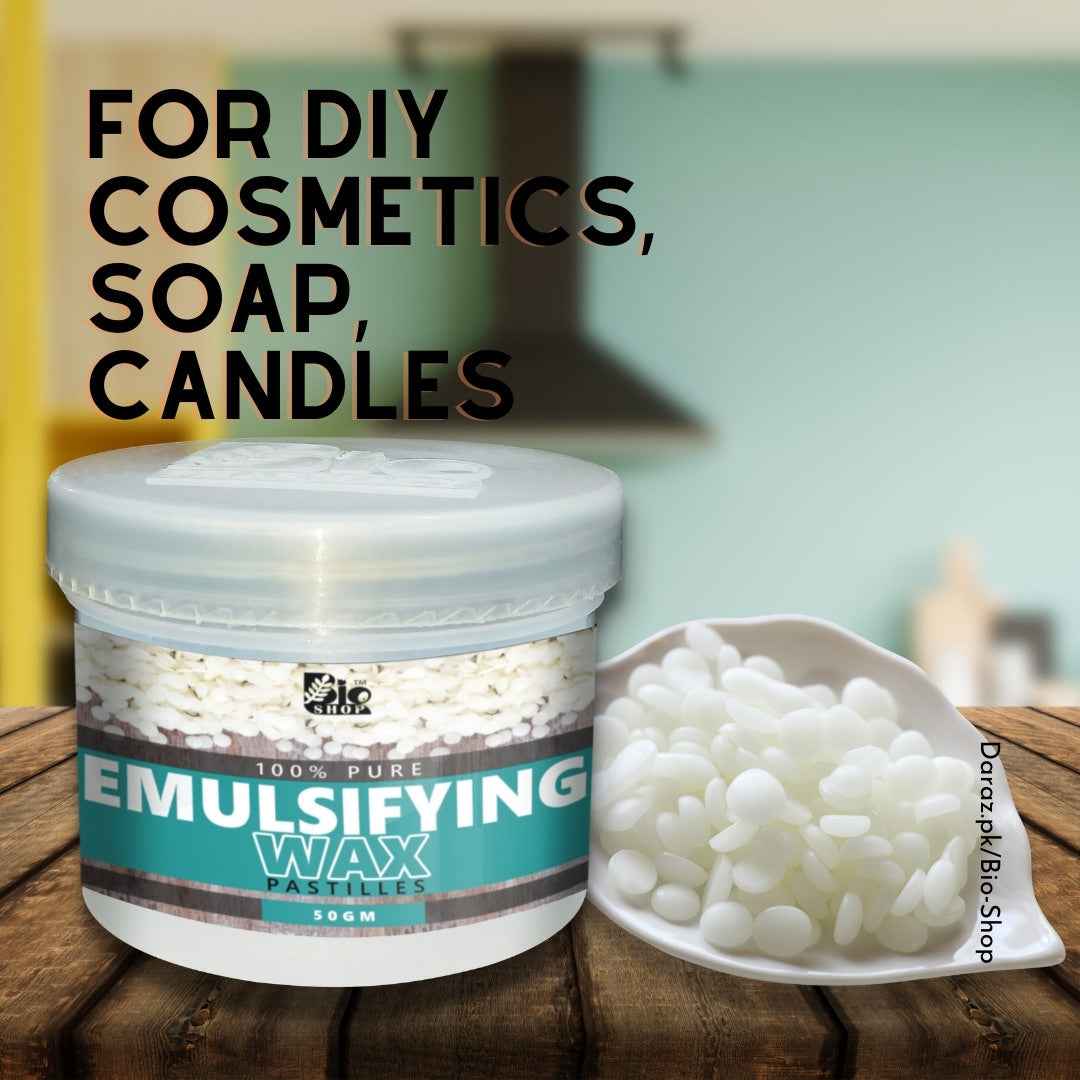
White Emulsifying Wax
White Emulsifying Wax
Key Functions: Emulsifies oil and water, thickens creams, stabilizes lotions, and improves texture.
Couldn't load pickup availability


Explore
Information About White Emulsifying Wax
✅ Key Features
✦ Primary O/W self-emulsifying wax that creates stable, smooth creams and lotions without a separate co-emulsifier
✦ Dual-function blend of Cetearyl Alcohol and Polysorbate 60 — emulsifies and thickens in a single ingredient
✦ Produces an elegant, non-greasy skin feel suitable for lightweight to medium-bodied emulsions
✦ Effective across skincare, haircare, and body care applications at low use levels of 2–8%
✦ Nonionic emulsifier — broadly compatible with actives, preservatives, and most cosmetic raw materials
✦ Beginner-friendly with consistent, predictable performance across a wide range of formula types
✦ Cosmetic-grade quality suitable for both rinse-off and leave-on finished products
🔬 Description
White Emulsifying Wax, commonly sold as E-Wax or Emulsifying Wax NF, is a nonionic self-emulsifying blend of Cetearyl Alcohol and Polysorbate 60. It has been a foundational ingredient in cosmetic and pharmaceutical formulation for decades, appearing in skin creams, pharmaceutical topicals, and personal care products worldwide. It is available in white to off-white pellet or flake form, making it easy to weigh, melt, and incorporate into both small-batch and large-scale production.
What makes White Emulsifying Wax particularly valuable is its self-emulsifying character. The Polysorbate 60 component acts as the primary emulsifier while Cetearyl Alcohol functions simultaneously as a co-emulsifier, thickener, and emollient — all in a single raw material. This eliminates the need to source and balance multiple emulsifying agents, streamlining the formulation process considerably. The result is a stable, creamy emulsion with a smooth application and a soft, pleasant finish on skin and hair.
Bio Shop Pakistan supplies cosmetic-grade White Emulsifying Wax suitable for DIY beauty formulators, home crafters, soap makers, hair care developers, and professional cosmetic manufacturers.
📊 Technical Data
INCI Name : Cetearyl Alcohol (and) Polysorbate 60
Chemical Name : Cetearyl Alcohol and Polyoxyethylene (20) Sorbitan Monostearate
CAS Number : Mixture — Cetearyl Alcohol: 67762-27-0; Polysorbate 60: 9005-67-8
Molecular Formula : Mixture — Not applicable as single formula
Appearance : White to off-white waxy pellets or flakes
Odor : Faint, waxy; practically odorless
pH (1% solution) : 6.0 – 7.0
Solubility : Dispersible in hot water; miscible with oils when melted
Specific Gravity : 0.87 – 0.95 (measured at 70°C, melted)
Flash Point : Above 100°C
HLB Value : 14 – 15
Recommended Use Level : 2 – 8% of total formula weight
Type : Nonionic O/W Self-Emulsifying Wax
Shelf Life : 24 months stored in cool, dry conditions; keep sealed
🧪 Recommended Usage
Skincare (Creams, Serums, Lotions) : ★★★★★
White Emulsifying Wax is the backbone of most O/W skin creams and body lotions, delivering reliable stability and a smooth application finish. Use at 4–6% with a balanced oil phase of 15–25% for a classic moisturizing cream.
Haircare (Shampoo, Conditioner, Masks) : ★★★★☆
It performs well in leave-in conditioning creams and hair milks where an O/W emulsion with light hold is required. Use at 3–5% for a fluid, non-greasy hair conditioning cream.
Soap Making (Cold Process, Melt and Pour) : ★★☆☆☆
White Emulsifying Wax is not suited to traditional cold process or melt-and-pour soap bases and offers negligible benefit in saponified formulas. It can be incorporated at low levels in syndet bars or emulsified scrub bases where an O/W emulsifier is needed.
Body Care (Scrubs, Butters, Balms) : ★★★★☆
Excellent for emulsified body butters and self-rinsing scrub bases where oil and water phases must be combined into a stable, pourable product. Use at 4–6% to stabilize emulsified scrub and body butter formulas effectively.
Functional Cosmetics (Deodorants, Sunscreen, Baby Care) : ★★★★☆
Performs reliably in sunscreen emulsion bases and gentle baby lotion formulas where a stable, mild O/W base is required. Confirm compatibility with UV filter actives and conduct freeze-thaw stability testing before commercial use.
💡 Pro Tip
As a formulator, White Emulsifying Wax is my first recommendation to anyone starting their cream-making journey. It is predictable, forgiving, and produces elegant emulsions across a wide range of oil phase percentages. I find it performs best when the total oil phase sits between 15 and 30% — go above that and you will need to increase the emulsifier level or add a secondary stabilizer. For professional work, I often layer it with a small percentage of Cetearyl Alcohol or Glyceryl Stearate to lift the skin feel from functional to truly luxurious.
ADVANCED TIP: To produce a lighter, more fluid emulsion with reduced heaviness, use White Emulsifying Wax at 3% combined with Glyceryl Stearate at 1.5% and Cetearyl Alcohol at 0.5%. Heat both phases independently to 72°C, then add the water phase to the oil phase in a slow, steady pour while mixing at medium speed. Switch to a hand homogenizer for 60 seconds once combined, then continue stirring until the batch cools below 40°C. This triblend approach reduces the occasionally waxy skin feel of E-Wax alone and produces a noticeably silkier, more elegant lotion texture.
👩🔬 Skin Type Suitability
Skincare (Creams, Serums, Lotions) : ★★★★★
White Emulsifying Wax is the backbone of most O/W skin creams and body lotions, delivering reliable stability and a smooth application finish. Use at 4–6% with a balanced oil phase of 15–25% for a classic moisturizing cream.
Haircare (Shampoo, Conditioner, Masks) : ★★★★☆
It performs well in leave-in conditioning creams and hair milks where an O/W emulsion with light hold is required. Use at 3–5% for a fluid, non-greasy hair conditioning cream.
Soap Making (Cold Process, Melt and Pour) : ★★☆☆☆
White Emulsifying Wax is not suited to traditional cold process or melt-and-pour soap bases and offers negligible benefit in saponified formulas. It can be incorporated at low levels in syndet bars or emulsified scrub bases where an O/W emulsifier is needed.
Body Care (Scrubs, Butters, Balms) : ★★★★☆
Excellent for emulsified body butters and self-rinsing scrub bases where oil and water phases must be combined into a stable, pourable product. Use at 4–6% to stabilize emulsified scrub and body butter formulas effectively.
Functional Cosmetics (Deodorants, Sunscreen, Baby Care) : ★★★★☆
Performs reliably in sunscreen emulsion bases and gentle baby lotion formulas where a stable, mild O/W base is required. Confirm compatibility with UV filter actives and conduct freeze-thaw stability testing before commercial use.
🧴 Formulation Ideas
As a formulator, White Emulsifying Wax is my first recommendation to anyone starting their cream-making journey. It is predictable, forgiving, and produces elegant emulsions across a wide range of oil phase percentages. I find it performs best when the total oil phase sits between 15 and 30% — go above that and you will need to increase the emulsifier level or add a secondary stabilizer. For professional work, I often layer it with a small percentage of Cetearyl Alcohol or Glyceryl Stearate to lift the skin feel from functional to truly luxurious.
ADVANCED TIP: To produce a lighter, more fluid emulsion with reduced heaviness, use White Emulsifying Wax at 3% combined with Glyceryl Stearate at 1.5% and Cetearyl Alcohol at 0.5%. Heat both phases independently to 72°C, then add the water phase to the oil phase in a slow, steady pour while mixing at medium speed. Switch to a hand homogenizer for 60 seconds once combined, then continue stirring until the batch cools below 40°C. This triblend approach reduces the occasionally waxy skin feel of E-Wax alone and produces a noticeably silkier, more elegant lotion texture.
💧 Safety and Regulatory:
INCI Declared : Yes — full INCI declaration required on finished product label
EU Cosmetics Reg : Permitted — no restriction listed under EU Cosmetics Regulation Annex; used as emulsifier and thickener
Rinse-Off Limit : No limit established at standard cosmetic use levels
Leave-On Limit : No limit established at standard cosmetic use levels
Allergen Alert : No — not a declared EU fragrance allergen; patch test advised for those with known surfactant sensitivities
Skin Safety : Safe at recommended levels of 2–8%
Eye Area Use : Use with caution — avoid direct mucous membrane contact; assess safety for eye contour products
Ingestion : Not for internal use
Pregnancy Use : Generally considered safe at cosmetic use levels; consult a physician for specialized applications
Child Safety : Safe for use in baby lotions and gentle leave-on products at standard dilution; avoid use on broken or inflamed skin
Ventilation : Not required under normal mixing and handling conditions
Storage : Cool, dry place away from direct heat, humidity, and sunlight; keep container sealed between uses
Container : HDPE or glass preferred — avoid prolonged storage in reactive metal containers
⚠️ Polysorbate 60, a key component of this blend, has been associated with rare skin sensitivity reactions in individuals with known surfactant or ethoxylated ingredient sensitivities. Conduct a full stability assessment and patch test on all finished formulations before market release or retail distribution.
Stability and Compatibility
Working pH Range : 4.0 – 8.0
Heat Stability : Stable; melt fully into oil phase at 65–75°C before combining with water phase
Freeze-Thaw Stable : No — repeated freeze-thaw cycles may cause phase separation; conduct cycling stability tests for commercial products
Emulsion Type : O/W (Oil-in-Water)
Emulsification Phase: Hot process — both phases must be heated to 65–75°C before combination
Compatible With : Fatty alcohols, carrier oils, esters, silicones, glycols, water-soluble actives, most broad-spectrum preservative systems
Incompatible With : High electrolyte concentrations above 5%, cationic emulsifiers, and strongly acidic systems below pH 4.0
Oxidation Risk : Low — Cetearyl Alcohol has low intrinsic oxidation tendency; add antioxidant to oil phase if using oxidation-prone carrier oils
Discoloration Risk : None under standard processing conditions — slight yellowing possible if heated above 80°C for extended periods
Formulation Notes : Always melt White Emulsifying Wax into the oil phase before combining with the heated water phase. Never add it to a cold or lukewarm water phase — it will not emulsify and will produce a grainy, unstable product. Maintain continuous stirring until the emulsion cools below 40°C to prevent phase separation during cooling.
❓ FAQs
Q: What is White Emulsifying Wax and what does it do in a cream formula?
A: White Emulsifying Wax is a self-emulsifying blend of Cetearyl Alcohol and Polysorbate 60 that allows oil and water to combine into a stable, smooth emulsion. It acts as both the emulsifier and a mild thickener, making it the core structural ingredient in most DIY O/W creams and lotions.
Q: How much White Emulsifying Wax should I use in a lotion or cream?
A: A starting range of 4–6% works well for most standard O/W creams with an oil phase of 15–25%. For lighter, more fluid lotions reduce to 3–4%, and for richer formulas with higher oil content move toward 6–8% to maintain stability.
Q: Do I need to add a co-emulsifier when using White Emulsifying Wax?
A: No — it is self-emulsifying and does not require a separate co-emulsifier. However, adding Cetearyl Alcohol at 1–2% or Glyceryl Stearate at 1–1.5% alongside it will noticeably improve the skin feel and produce a creamier, more elegant finished texture.
Q: Can I use White Emulsifying Wax to make a hair conditioner?
A: Yes, it works well in leave-in conditioning creams and hair milks at 3–5%. For rinse-out conditioners requiring detangling and slip, pairing it with or replacing it with a cationic conditioning emulsifier such as BTMS-50 will produce significantly better conditioning and anti-static performance.
Q: How does White Emulsifying Wax compare to BTMS-50?
A: White Emulsifying Wax is a nonionic O/W emulsifier designed for skin creams, body lotions, and light hair products, with no conditioning charge. BTMS-50 is a cationic conditioning emulsifier engineered specifically for hair care, providing superior detangling, moisture retention, and anti-static performance that nonionic E-Wax cannot replicate; for serious hair formulations, BTMS-50 is the stronger choice.
Where Can You Safely Use White Emulsifying Wax
Discover how White Emulsifying Wax performs across different products — rated for safety, stability, and effectiveness.