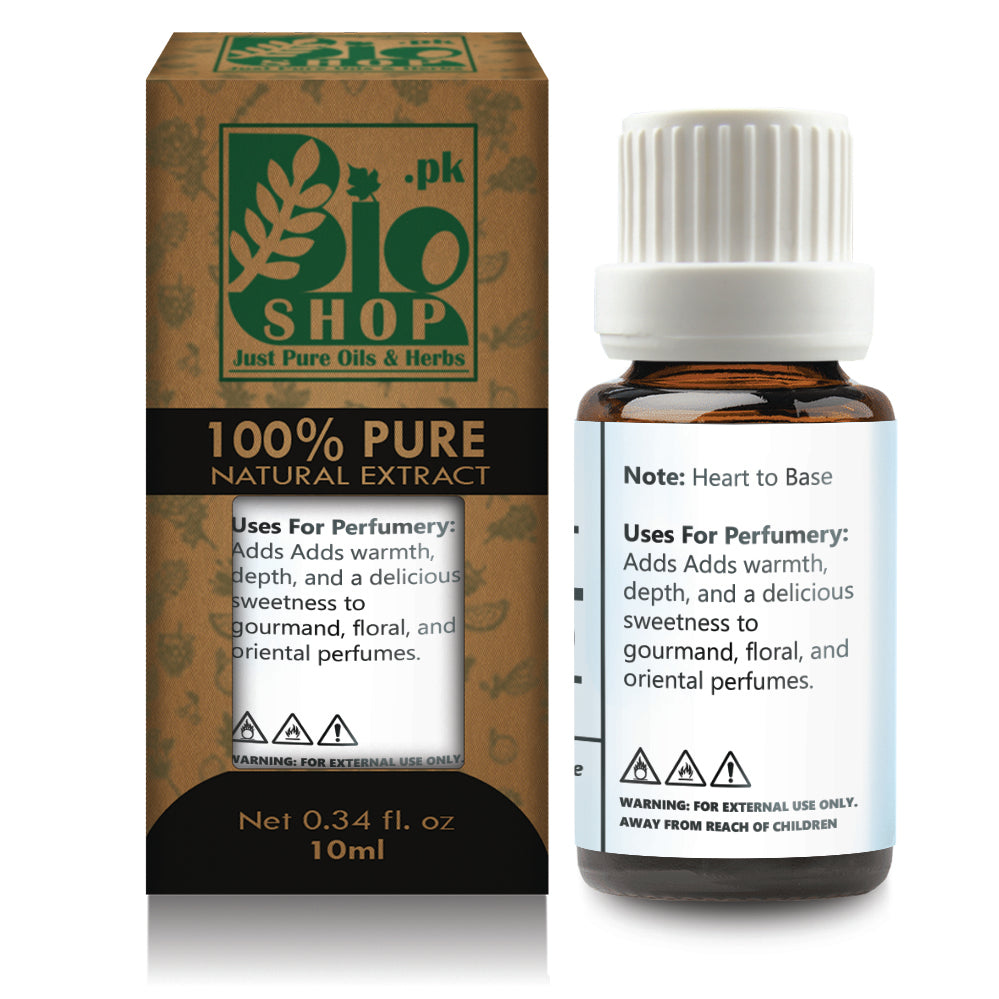
Bio Shop
Safranal (10% in DPG)
Safranal (10% in DPG)
Olfactory Notes: Saffron · Warm · Spicy · Leathery · Sweet · Slightly Medicinal
Couldn't load pickup availability

Explore
Information About Safranal (10% in DPG)
Key Features
- 10% pre-diluted in DPG for ease of use
- Adds an exotic, warm leathery depth to fine fragrance bases
- Ideal for oriental, leather, oud, spicy, and ambery compositions
- Powerful and long-lasting in trace amounts
- Excellent in attars, oil-based perfumes, mists, and incense blends
About Safranal (10% in DPG)
Safranal (10% in DPG) is a pre-diluted version of the unique and luxurious aroma compound Safranal, the principal odorant of natural saffron. With its warm, leathery, spicy, slightly woody, and hay-like aroma, Safranal delivers a rich oriental depth to perfumes and attars. This 10% dilution in DPG (Dipropylene Glycol) makes it easy to dose and incorporate into oud, amber, incense, oriental, and leather compositions.
Safranal works best as a supportive modifier to recreate the complex aroma of saffron or to add an exotic twist to ambery or woody blends. It blends especially well with materials like Ambroxan, Tolu Balsam, Iso E Super, and Civet for high-end, sophisticated fragrance formulations
Olfactory Profile
SCENT DESCRIPTION : Safranal opens with an immediate burst of warm, hay-inflected saffron — rich, earthy, and slightly animalic — before settling into a rounder, more floral heart with subtle medicinal and leathery undertones. There is a dry, almost dusty quality reminiscent of aged spice markets and precious textiles, punctuated by soft floral warmth that bridges saffron's spice character with the depth of rose and oud. At low concentrations it reads as a sophisticated oriental modifier; at higher doses it becomes the undeniable signature of the formula. It lingers long on skin with a quietly powerful, intimate presence.
NOTE POSITION : Mid / Mid-Base
FRAGRANCE FAMILY : Oriental · Spicy · Earthy-Leathery
FACETS : Saffron · Hay · Earthy · Leathery · Floral-Warm
TENACITY : High — 10 to 14 hours on skin, excellent on fabric
SILLAGE : Medium — intimate and close-wearing, with depth that projects softly rather than loudly; well-suited to skin-close attar-style application
Technical Specifications
Chemical Name : 2,6,6-Trimethylcyclohexa-1,3-diene-1-carbaldehyde
CAS Number : 116-26-7
Synonyms : Safranal; 2,6,6-Trimethyl-1,3-cyclohexadiene-1-carboxaldehyde; Saffron Aldehyde
Molecular Formula : C10H14O
Molecular Weight : 150.22 g/mol
Purity : 95%+ (verify with supplier CoA)
Appearance : Colorless to pale yellow oily liquid
Odor Threshold : Approximately 0.07–0.5 ppb in air (extremely potent)
Solubility : Soluble in ethanol, IPM, DPG; practically insoluble in water
Specific Gravity : Approximately 0.970–0.975 g/cm³ at 20°C (verify with supplier)
Flash Point : Approximately 71°C (verify with supplier SDS)
Type : Synthetic aroma chemical (nature-identical)
Applications & Usage Guidelines
Use 1–2% of this 10% Safranal blend to add a luxurious saffron note to leather, oud, or amber perfumes. Blend with Ambroxan for a warm modern base, or with Tolu Balsam and Civet for a traditional spicy oriental effect.
IFRA & Usage Rate
Recommended Usage Rates
EDP (Eau de Parfum) : 0.005% to 0.015%
EDT (Eau de Toilette) : 0.003% to 0.010%
Body Lotion : 0.005% to 0.010%
Shampoo / Body Wash : 0.005% to 0.010%
Candle : 0.01% to 0.05%
Reed Diffuser : 0.05% to 0.1%
Soap (bar) : 0.005% to 0.010%
Note: Safranal is extremely potent. Even at 0.005% in a formula, its saffron character registers clearly. Begin at the lowest recommended rate and adjust upward with care.
IFRA 51st Amendment Compliance
⚠️ Safranal (CAS 116-26-7) is a RESTRICTED ingredient under the IFRA 51st Amendment due to skin sensitization potential. Maximum permitted concentrations vary by category. Representative limits are listed below — always verify against the official IFRA standard and conduct a full QRA before commercial production.
IFRA Category 1 (Lip products) : 0.002% (verify)
IFRA Category 4 (Fine fragrance, EDP, EDT) : 0.02% (verify)
IFRA Category 5A (Body lotion, face cream) : 0.01% (verify)
IFRA Category 7A (Rinse-off hair products) : 0.01% (verify)
IFRA Category 8 (Rinse-off body products) : 0.01% (verify)
IFRA Category 10A (Candles) : No restriction currently established — verify
IFRA Category 11A (Incense, room sprays) : No restriction currently established — verify
⚠️ Limits listed are indicative. Always download the current IFRA 51st Amendment standard from ifrafragrance.org and verify category limits before use in any product intended for commercial sale.
⚠️ Safranal is a known skin sensitizer at higher concentrations. Patch testing and QRA review are strongly recommended for all leave-on skin contact applications.
Blending Guide
Method 1 — Dilution in DPG or IPM
Safranal is most easily worked with at a 1% or 10% dilution in dipropylene glycol (DPG) or isopropyl myristate (IPM). This allows precise dosing, prevents over-addition, and improves dispersibility in base formulations. Always prepare a 1% dilution for evaluation before building into a full formula.
Method 2 — Layering in Saffron-Rose-Oud Accords
In attar construction, introduce safranal at the base-build stage when layering saffron with rose absolute or rose oxide, oud oil or oud aroma chemicals, and an amber or musk base. Allow the accord to macerate for 24 to 48 hours before evaluating the integrated saffron character. Safranal blends slowly and the full character emerges after resting.
Method 3 — Micro-dosing as a Modifier
In fine fragrance and oriental compositions, safranal functions powerfully as a modifier even below 0.01% in the final formula. Use it to add authentic spice depth to floral, leathery, or amber bases without making saffron the dominant theme. At these trace levels it enriches the composition without announcing itself as saffron.
BEST PAIRINGS
Rose Absolute / Rose Otto → Classic saffron-rose accord; the combination is the backbone of most Persian and Khaleeji attar styles
Oud Oil / Oud Aroma Chemicals → Deepens into a dark, resinous saffron-oud accord with leathery warmth
Ambroxan / Ambergris Ketone → Creates a modern, skin-close saffron-amber composition with excellent tenacity
Vetiver → Earthy, rooty counterpoint that grounds safranal and adds complexity
Frankincense / Olibanum → Resinous, slightly citrus-edged pairing that reads as sacred and meditative
Labdanum / Cistus → Deepens the leathery-animalic facet of safranal into a full chypre-oriental direction
Iris / Orris → Powdery, carrot-tinged pairing that reads as prestige oriental with soft floral depth
Hedione / Methyl Dihydrojasmonate → Lifts safranal's heavier facets and adds transparency and diffusion
AVOID
Strongly acidic fragrance ingredients and high-pH formulations may cause degradation of the aldehyde group. Avoid combining safranal with highly alkaline soap bases without thorough stability testing, as discoloration and scent instability may occur. Keep away from formulations with significant water content unless solubilized and stability-tested.
Safety & Storage
Physical State : Colorless to pale yellow oily liquid at room temperature
Skin Safety : Known skin sensitizer — use strictly within IFRA limits; patch test all leave-on applications; avoid undiluted skin contact
Eye Contact : Irritant — avoid contact; flush immediately with clean water for 15 minutes if contact occurs; seek medical advice if irritation persists
Ingestion : Not for internal use; keep away from food, beverages, and children
Ventilation : Work in a well-ventilated area or under a fume hood when handling concentrated material; vapors are potent at very low concentrations
Storage : Store in a sealed, airtight amber glass or HDPE container away from heat, light, and moisture; recommended storage temperature 10°C to 25°C
Shelf Life : 24 to 36 months when stored correctly in sealed original container; aldehyde functionality may degrade with oxidation — monitor for off-notes
Container : Amber glass preferred; avoid reactive metals; keep tightly capped when not in use
Flammability : Combustible liquid — flash point approximately 71°C; keep away from open flames and ignition sources during formulation and storage
FAQ
Q1: What does Safranal smell like?
It has a warm, leathery, spicy aroma similar to natural saffron with herbal and woody nuances.
Q2: Can I use this in attars or oil-based perfumes?
Yes, this DPG-diluted version is suitable for oil-based systems, roll-ons, and mists.
Q3: Is Safranal a synthetic version of saffron?
Safranal is a natural compound found in saffron, but this product is typically synthesized for consistency and purity in perfumery.
Q4: Does it need to be used in small amounts?
Yes—Safranal is very potent. Even at 10% dilution, you typically only need 1–3% in your formula.
Q5: Can I blend it with oud and amber notes?
Absolutely. It blends exceptionally with oud, amber, tolu, resins, and musks to create exotic, high-end scents.
Where Can You Safely Use Safranal (10% in DPG)?
Discover how Safranal (10% in DPG) performs across different applications—rated for safety, stability, and effectiveness.
Good product
Good performance