Skip to product information
1 of 4

Bio Shop

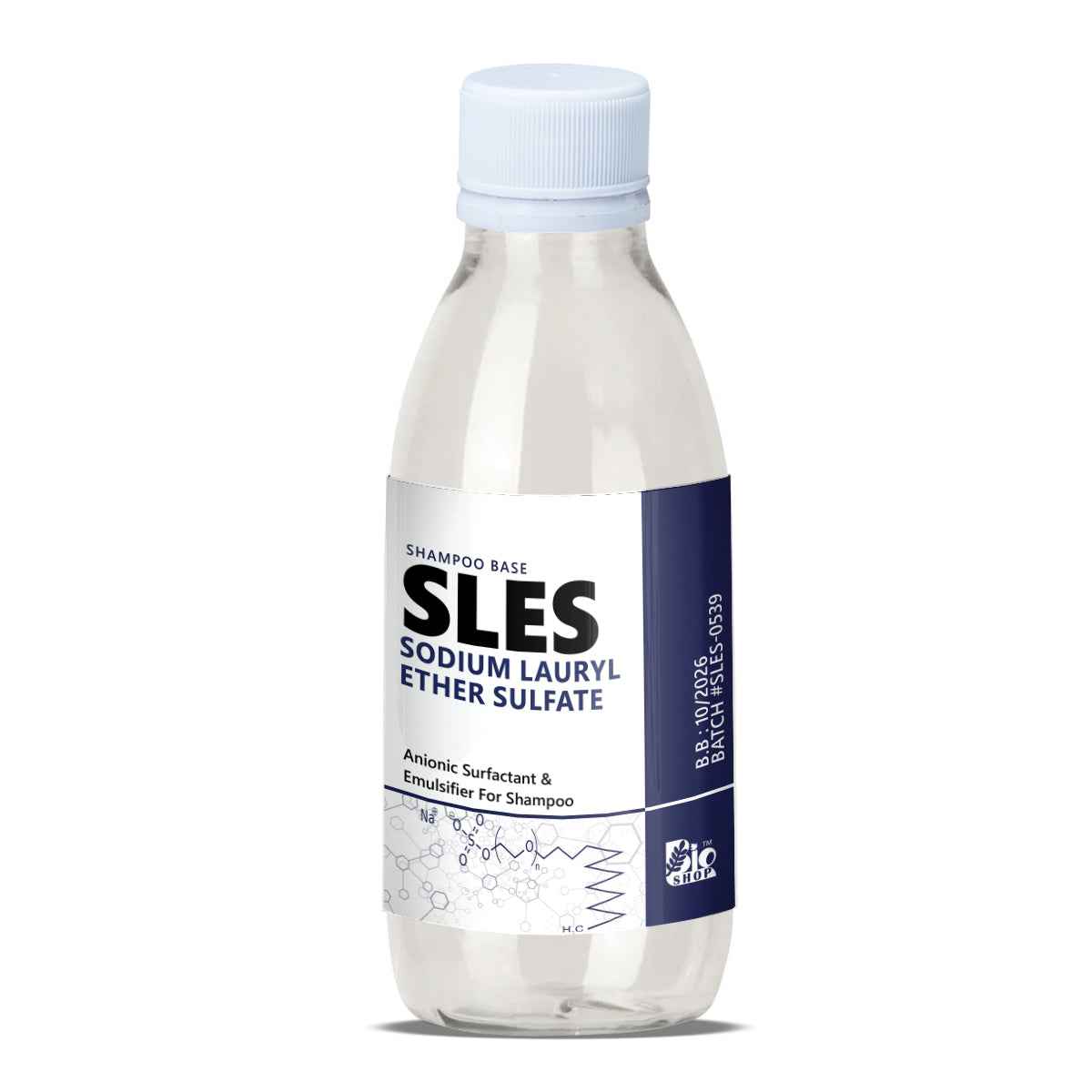
SLES (Sodium Lauryl Ether Sulfate)

SLES (Sodium Lauryl Ether Sulfate)

Regular price Rs.220.00
Regular price Sale price Rs.220.00
Sale Sold out
Shipping calculated at checkout.

Key Functions: Produces rich foam, cleanses effectively, removes oil and dirt, and thickens easily with salt.

Volume
Quantity
🚚 Estimated delivery time:
Learn More About This Ingredient View full details

Explore

Information About SLES (Sodium Lauryl Ether Sulfate)

✅ Key Features

✦ Delivers high-volume, dense foam ideal for shampoos, body washes, and liquid cleansers.
✦ Milder than SLS due to ethoxylation, making it more suitable for daily-use personal care products.
✦ Excellent grease and sebum removal without excessive stripping of the skin barrier.
✦ Easily thickened with sodium chloride, reducing the need for expensive rheology modifiers.
✦ Compatible with amphoteric, nonionic, and cationic co-surfactants for balanced formulations.
✦ Performs reliably across a pH range of 5.5 to 10, supporting diverse product formats.
✦ Cost-effective primary surfactant widely used in commercial and handmade cosmetic production.

🔬 Description

SLES, or Sodium Lauryl Ether Sulfate, is an anionic surfactant derived from lauryl alcohol through ethoxylation and subsequent sulfonation. It was developed in the mid-twentieth century as a gentler alternative to Sodium Lauryl Sulfate and quickly became the backbone surfactant in the global personal care industry. Today it remains one of the highest-volume cleansing agents used in shampoos, shower gels, and household cleaning products worldwide.

What makes SLES particularly valuable to formulators is its combination of high foaming power, effective cleansing, and relatively mild skin interaction. The ethylene oxide units in its molecular chain act as a buffer between the sulfate head group and the skin surface, reducing irritation potential compared to non-ethoxylated sulfates. It also responds exceptionally well to salt thickening, allowing formulators to build viscosity inexpensively without complex polymer systems.

Bio Shop Pakistan supplies cosmetic-grade SLES suitable for DIY beauty formulators, professional cosmetic chemists, soap makers, and home crafters.

📊 Technical Data

INCI Name : Sodium Laureth Sulfate
Chemical Name : Sodium Lauryl Ether Sulfate (with 2-3 moles ethylene oxide)
CAS Number : 9004-82-4 (68585-34-2 for C12-14 range)
Molecular Formula : CH3(CH2)11(OCH2CH2)nOSO3Na (n = 2-3 typically)
Appearance : Clear to slightly hazy viscous liquid (70% active) or paste
Odor : Mild, characteristic surfactant odor
pH (1% solution) : 7.0 to 9.5
Solubility : Freely soluble in water
Specific Gravity : 1.04 to 1.06 (at 70% active matter)
Flash Point : Not applicable (aqueous solution)
HLB Value : 40 (strongly hydrophilic)
Recommended Use Level : 5% to 25% active matter in finished formulations
Type : Anionic surfactant
Shelf Life : 24 months when stored properly

🧪 Recommended Usage

Skincare (Facial Cleansers, Micellar Gels) ★★★☆☆
SLES can be used in wash-off facial cleansers at low concentrations but is not the first choice for sensitive facial skin. Use at 3 to 8 percent active and always pair with a mild co-surfactant like Cocamidopropyl Betaine to reduce irritation potential.

Haircare (Shampoo, Clarifying Treatments) ★★★★★
This is where SLES excels — it is the world's most popular primary shampoo surfactant. Use at 8 to 15 percent active in daily shampoos and up to 20 percent in clarifying or deep-cleansing formulas.

Liquid Soap and Body Wash ★★★★★
SLES produces luxurious lather in shower gels, hand washes, and bubble baths with excellent rinse-off feel. Thicken easily with 1 to 3 percent sodium chloride and boost mildness with an amphoteric secondary surfactant.

Body Care (Scrubs, Foaming Treatments) ★★★★☆
Works well in rinse-off body scrubs and foaming body treatments where strong lather enhances the user experience. Keep contact time short and concentration moderate at 5 to 12 percent active.

Household and Functional Products (Dish Soap, All-Purpose Cleaners) ★★★★★
SLES is a workhorse in household cleaning due to its powerful degreasing ability and high foam output. Formulators can use it at 10 to 25 percent active for heavy-duty cleaning applications.

💡 Pro Tip

In my years of formulating cleansing products, I have learned that the single biggest mistake beginners make with SLES is adding too much salt too fast. SLES viscosity follows a bell curve with salt concentration — add too much and your product thins out irreversibly, forcing you to start over. I always build a salt curve for every new SLES batch by testing small samples at 0.5 percent salt increments before scaling up.

ADVANCED TIP: To create a salon-grade clarifying shampoo, blend SLES at 12 percent active with Cocamidopropyl Betaine at 4 percent and Sodium Cocoyl Isethionate at 2 percent. Adjust pH to 5.5 with citric acid, then add sodium chloride in 0.5 percent increments until you hit your target viscosity peak. This three-surfactant system gives excellent flash foam, creamy lather, and a non-stripping after-feel.

👩‍🔬 Skin Type Suitability

Normal Skin : ★★★★☆ — Effective in rinse-off products; pair with a mild co-surfactant for daily use.
Dry Skin : ★★☆☆☆ — Can strip natural lipids if used alone at high concentration; always co-formulate with humectants.
Oily Skin : ★★★★★ — Excellent sebum removal makes it ideal for oily and combination cleansing needs.
Combination : ★★★★☆ — Works well when balanced with amphoteric surfactants to avoid over-cleansing dry zones.
Sensitive Skin : ★★☆☆☆ — May cause irritation in sensitive individuals; use at low levels or choose a milder alternative.
Mature Skin : ★★☆☆☆ — Mature skin has a compromised barrier; use sparingly and only in quick rinse-off formats.
Acne-Prone : ★★★★☆ — Thorough cleansing helps manage excess oil, but avoid leave-on contact and over-cleansing.

🧴 Formulation Ideas

CONCEPT 1: Volumizing Daily Shampoo
Usage Level : 12% active SLES
Key Ingredients: Cocamidopropyl Betaine, Polyquaternium-10, Panthenol, Sodium Chloride
Result : A high-foam, salt-thickened shampoo that cleanses thoroughly while depositing a light conditioning film for volume and manageability.

CONCEPT 2: Refreshing Citrus Body Wash
Usage Level : 10% active SLES
Key Ingredients: Decyl Glucoside, Glycerin, Citric Acid, Sweet Orange Essential Oil
Result : A creamy, pH-balanced shower gel with dense lather, skin-friendly mildness, and a fresh citrus scent.

CONCEPT 3: Foaming Antibacterial Hand Soap
Usage Level : 8% active SLES
Key Ingredients: Cocamidopropyl Betaine, Aloe Vera Extract, Tea Tree Essential Oil, Sodium Benzoate
Result : A gentle yet effective foaming hand wash with natural antibacterial properties and a soothing aloe after-feel.

💧 Safety and Regulatory:

INCI Declared : Yes — required in all cosmetic products
EU Cosmetics Reg : Permitted — no maximum concentration limit for rinse-off; subject to purity requirements for 1,4-dioxane and ethylene oxide residues
Rinse-Off Limit : No specific limit established; industry standard up to 25% active
Leave-On Limit : Not recommended for leave-on products
Allergen Alert : No — not a classified allergen, but may cause irritation at high concentrations
Skin Safety : Safe at recommended levels in rinse-off products; patch test advised for sensitive individuals
Eye Area Use : Avoid — can cause significant eye irritation
Ingestion : Not for internal use
Pregnancy Use : Safe in normal rinse-off cosmetic use
Child Safety : Safe in rinse-off products formulated for children above 3 years; use at reduced concentrations
Ventilation : Recommended when handling concentrated stock to avoid inhaling mist
Storage : Cool dry place, away from direct sunlight and extreme heat
Container : HDPE or PET containers; avoid reactive metals

⚠️ SLES raw material must meet strict limits for 1,4-dioxane (below 10 ppm) and ethylene oxide residues (below 1 ppm) per EU and FDA guidelines. Always request a Certificate of Analysis from your supplier confirming these residue levels.

Stability and Compatibility

Working pH Range : 5.0 to 10.0 (optimal performance at pH 6.0 to 8.0)
Heat Stability : Stable up to 80°C; can be processed at elevated temperatures during manufacturing
Freeze-Thaw Stable : No — concentrated SLES may crystallize or phase-separate below 10°C; warm gently to restore
Emulsion Type : Not applicable — surfactant, not an emulsifier in the traditional sense
Emulsification Phase: Added to the water phase during compounding
Compatible With : Amphoteric surfactants, nonionic surfactants, cationic polymers, electrolytes, most preservatives
Incompatible With : High concentrations of cationic surfactants, strong oxidizing agents, highly acidic systems below pH 3
Oxidation Risk : Low — not prone to oxidation under normal storage
Discoloration Risk : Possible — may yellow over time if exposed to UV light or stored at high temperatures
Formulation Notes : Always add salt gradually while mixing to control viscosity. Pre-dissolve any powdered co-surfactants before combining with SLES to prevent lumping.

❓ FAQs

Q: What is the difference between SLS and SLES?
A: SLS (Sodium Lauryl Sulfate) and SLES (Sodium Lauryl Ether Sulfate) are both anionic surfactants, but SLES has been ethoxylated, which adds ethylene oxide units to the molecule. This ethoxylation makes SLES significantly milder on skin while retaining strong foaming and cleansing power.

Q: How do I thicken a shampoo made with SLES?
A: The simplest method is salt thickening. Dissolve sodium chloride at 0.5 percent increments into your finished formula while stirring until you reach the desired viscosity. Be careful not to overshoot, as excess salt will thin the product back down.

Q: Can I use SLES in cold process soap?
A: No. SLES is a synthetic surfactant used in liquid and gel formulations, not in traditional cold process soap which relies on saponification of fats. It is suitable for syndet bars, liquid soaps, and melt-and-pour bases designed for surfactant systems.

Q: Is SLES safe for baby products?
A: SLES can be used in rinse-off baby products at reduced concentrations, typically 3 to 6 percent active, combined with a mild co-surfactant. However, many baby care brands prefer sulfate-free alternatives like Decyl Glucoside or Sodium Cocoyl Isethionate for marketing and mildness reasons.

Q: How does SLES compare to Sodium Cocoyl Isethionate as a primary surfactant?
A: Sodium Cocoyl Isethionate is significantly milder and produces a creamier, denser lather, but it costs more and does not thicken as easily with salt. SLES is more cost-effective, generates higher-volume foam, and is easier to formulate with, making it the preferred choice for budget-friendly and high-foam products.

Where Can You Safely Use SLES (Sodium Lauryl Ether Sulfate)

Discover how SLES (Sodium Lauryl Ether Sulfate) performs across different products — rated for safety, stability, and effectiveness.

Skincare
Serums
0
Not Recommended
Creams & Lotions
0
Not Recommended
Eye Creams
0
Not Recommended
Face Masks
5
Mediocre
Cleansers
7
Reasonable
Toners
0
Not Recommended
Lip Balms
0
Not Recommended
Ointments
0
Not Recommended
Body & Hair Care
Body Butters
0
Not Recommended
Shampoos
9
Very Good
Conditioners
0
Not Recommended
Hair Masks
0
Not Recommended
Soap & Specialty
Soaps
8
Good
Deodorants
0
Not Recommended