Bio Shop
Jasmine powder
Jasmine powder
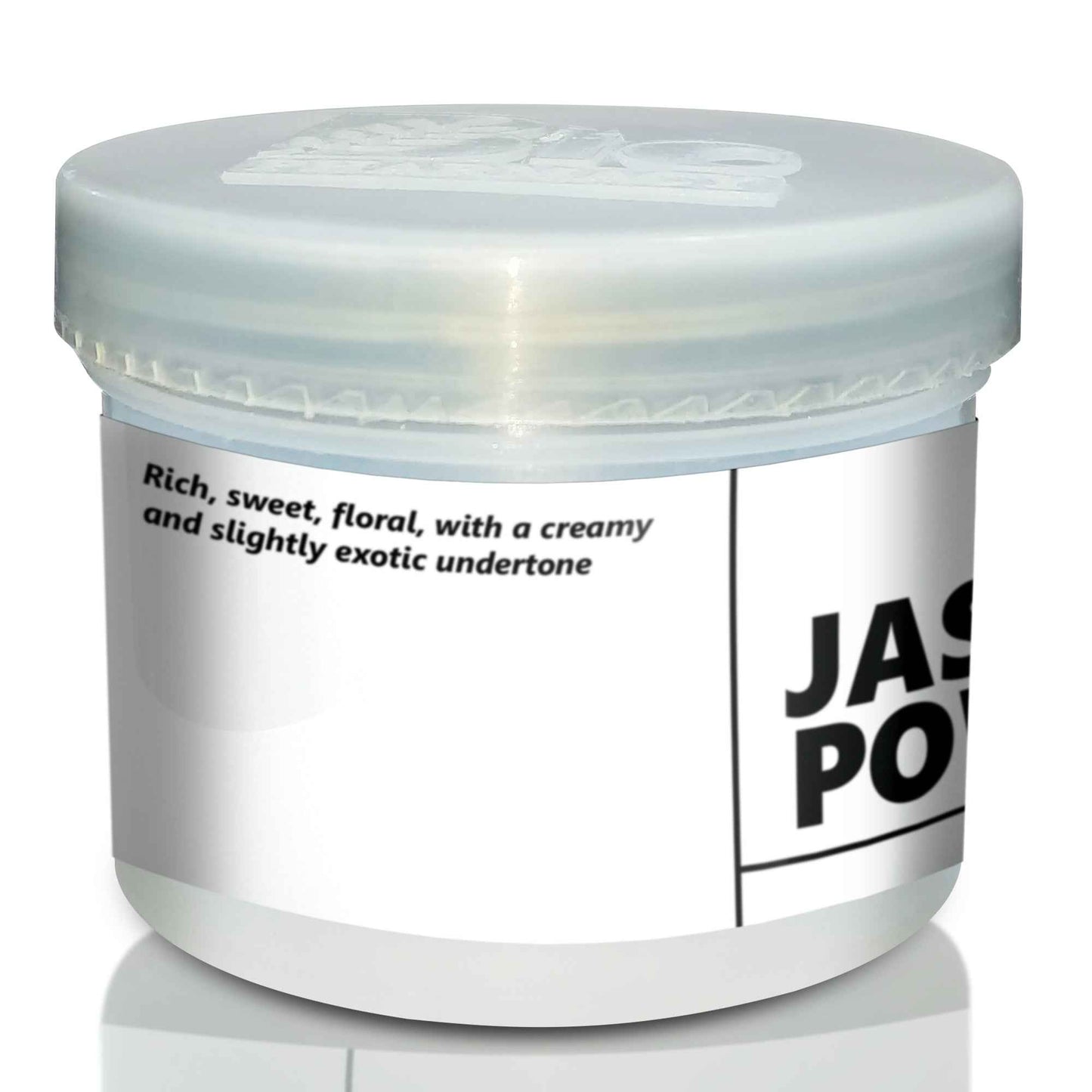
Olfactory Notes: Honeyed, floral, jasmine-like with sweet nuance.
Couldn't load pickup availability


Explore
Information About Jasmine powder
Key Features
✦ Sweet honey-floral aroma chemical with natural jasmine and rose character
✦ Occurs naturally in jasmine absolute and rose oil — adds genuine naturalness to blends
✦ Exceptional for oriental, attar, and soliflore jasmine compositions
✦ Functions as both a modifier and a diffusion booster in floral accords
✦ Low use levels required — extremely potent and diffusive at threshold concentrations
✦ Compatible with musks, woods, resins, and heavy florals
✦ Synthetic origin — vegan, not derived from animal or botanical extraction
About Jasmine powder
Phenylacetic acid, sold in the fragrance trade under the informal name Jasmine Powder, is one of the oldest known aromatic building blocks in perfumery. It is a naturally occurring organic acid found in trace quantities in jasmine absolute, rose oil, honey, and certain fruits. Its discovery as a fragrance-significant compound dates back to early 20th-century analytical work on jasmine flowers, and it has been used in classical perfumery compositions ever since. The synthetic form is produced commercially through the reaction of benzyl chloride with sodium cyanide followed by hydrolysis, yielding a white crystalline solid that melts slightly above room temperature.
What makes phenylacetic acid remarkable is its dual character. At high concentrations it is overwhelmingly sharp and diffusive, almost unpleasant to the unaccustomed nose. At trace levels it performs an extraordinary transformation, lending a warm, waxen, honeyed jasmine quality that is unmistakably floral yet complex. This duality means it must be used with considerable care and precision. It is not a standalone material but a modifier and enhancer that elevates surrounding floral, musky, and resinous accords with a naturalness that purely synthetic jasmine molecules cannot replicate. Its odor contribution at low doses mimics the character of true jasmine absolute at a fraction of the cost.
Bio Shop Pakistan supplies cosmetic and fragrance grade phenylacetic acid suitable for professional perfumers, attar blenders, and advanced DIY formulators working with oriental, floral, and honey-based compositions.
Olfactory Profile
SCENT DESCRIPTION : Phenylacetic acid opens with a sharply sweet, diffusive honey-wax character that quickly settles into a rich floral warmth. At working concentrations it evokes sun-warmed jasmine petals with an underlying animalic softness and faint roselike creaminess. The dry down is waxy, beeswax-adjacent, and intimate. It does not read as a clean or ozonic material — it is decidedly warm, plush, and Oriental in character.
NOTE POSITION : Mid-Base
FRAGRANCE FAMILY : Floral Oriental · Honey · Chypre
FACETS : Honey · Jasmine · Waxy · Animalic · Rose
TENACITY : Medium-High — perceptible on skin for 6 to 10 hours at effective concentrations
SILLAGE : Medium — diffusive in the opening, settles close to skin in the dry down
Technical Specifications
Chemical Name : Benzeneacetic acid (Phenylacetic acid)
CAS Number : 103-82-2
Synonyms : Jasmine Powder, Alpha-Toluic Acid, Benzyl Carboxylic Acid, PAA
Purity : 99% minimum (verify with supplier batch certificate)
Appearance : White to off-white crystalline solid or powder at room temperature; melts to colorless liquid at approximately 76–77°C
Odor Threshold : Approximately 0.5–2 ppm in air — extremely potent, handle with care
Solubility : Slightly soluble in water; freely soluble in alcohol (ethanol), ether, and warm dipropylene glycol
Specific Gravity : 1.09 (liquid at 80°C); appears as solid at ambient Pakistani room temperatures
Flash Point : Approximately 132°C (270°F) — relatively non-flammable under normal conditions
Type : Synthetic (also found naturally in jasmine absolute, rose oil, and honey)
Applications & Usage Guidelines
Fine Fragrance : ★★★★★
Phenylacetic acid is a classical fine fragrance material used in jasmine soliflores, chypres, and Oriental compositions. It provides the warm honey-waxy undertone that gives classical jasmine perfumes their complexity and naturalness. Use at 0.05 to 0.3% in the final formula for best effect.
Attar and Oriental Blending : ★★★★★
Phenylacetic acid is exceptionally well-suited to attar and concentrated oil-based Oriental compositions. It reinforces jasmine, rose, and oud accords with an authentic floral-honey depth. Its performance in non-alcoholic formats is excellent and historically valued in Indo-Arabic perfumery traditions.
Functional Fragrance : ★★★☆☆
Usable in functional fragrance applications at very low levels but stability in surfactant systems and high-pH bases requires testing. Its sharp character may be amplified in rinse-off products. Keep usage rates conservative and confirm compatibility with the product base.
Cosmetics : ★★★☆☆
Can be incorporated into skin-safe cosmetic formulations where a floral or honey note is desired. Must be used within safe skin exposure limits. Patch testing is advisable. Not recommended for leave-on products near eyes or mucous membranes without full safety assessment.
Home Fragrance : ★★★★☆
Effective in reed diffusers and incense formulations where its diffusivity can be showcased. Not recommended for candles as its low melting point and behavior at elevated temperatures may cause issues. Works well in room sprays and cold diffusion applications.
IFRA & Usage Rate
RECOMMENDED USAGE RATES
EDP / Extrait : 0.1 – 0.5%
EDT : 0.05 – 0.3%
Body Lotion / Cream : 0.01 – 0.1%
Shampoo / Body Wash : 0.01 – 0.05%
Candle : Not recommended (stability concerns at pour temperatures)
Reed Diffuser : 0.1 – 0.5% in diffuser base
Bar Soap : 0.05 – 0.2% (pH and saponification may affect odor character)
IFRA 51ST AMENDMENT STATUS
Phenylacetic acid does not appear as a specifically restricted or prohibited material in the IFRA 51st Amendment standards as a standalone ingredient at the time of this writing. However, as a potent and reactive aromatic acid it should be treated with caution.
⚠️ Always apply the lowest effective use concentration.
⚠️ Conduct dermal sensitisation risk assessment (QRA) before finalising any leave-on product.
⚠️ Verify current IFRA status with supplier SDS and the official IFRA standards library before commercial use.
Blending Guide
METHOD 1 — PRE-DILUTION IN DPG
Phenylacetic acid is a solid at room temperature. Melt gently in a warm water bath (below 90°C) and dissolve in dipropylene glycol (DPG) at a 10% concentration before use. This prevents handling errors and allows precise micro-dosing into formulas. Never heat above 100°C.
METHOD 2 — JASMINE ACCORD CONSTRUCTION
Use phenylacetic acid as the honey-waxy backbone of a jasmine accord. Combine with methyl dihydrojasmonate (Hedione), indole, benzyl acetate, and linalool to construct a realistic jasmine heart. Phenylacetic acid provides the warmth and naturalness that synthetic jasmine molecules alone cannot replicate. Start at 0.05% in the final blend.
METHOD 3 — ORIENTAL BASE ENHANCEMENT
In oud, resinous, or honey-forward Oriental compositions, add phenylacetic acid at 0.05 to 0.15% to enrich the warm base. It pairs naturally with labdanum, benzyl benzoate, iso eugenol, and heavy musks, giving depth and an authentic attarlike quality to the dry down.
BEST PAIRINGS
Methyl Dihydrojasmonate → Amplifies jasmine floralcy; creates realistic jasmine heart
Indole → Adds animalic depth and night-blooming floral authenticity
Benzyl Acetate → Brightens the floral character and adds freshness
Linalool → Softens and rounds the waxy honey character
Labdanum Absolute → Deep resinous-animalic foundation; classic Oriental pairing
Iso Eugenol → Rose-spicy warmth that complements the honey facets
Hedione (Methyl Dihydrojasmonate) → Transparent jasmine lift that balances PAA's heaviness
Galaxolide / Habanolide → Clean musky dry down that grounds the animalic character
Benzyl Benzoate → Fixative and diluent; also extends and softens the honey note
Oud / Agarwood → Animalic-resinous pairing of profound Oriental character
AVOID
Avoid using phenylacetic acid in high concentrations alongside aldehydic top notes — it can create an overpowering and unbalanced fatty-acid impression at elevated levels. Avoid use in aqueous systems without careful pH management as it is a weak acid and may affect formulation pH.
Perfumer's Note
I think of phenylacetic acid as the smell of jasmine remembered, rather than jasmine experienced. It is not the bright, green-indolic freshness of the living flower. It is the warmth left on the pillow after, the honeyed residue on sun-dried petals, the beeswax candle burning in a room full of flowers. When you add it to a jasmine accord at 0.1% or below, something shifts — the synthetic molecules stop sounding like molecules and start sounding like a flower. That is the magic this material brings, and why classical perfumers have never fully retired it despite a century of newer jasmine molecules entering the palette.
ADVANCED TIP
When working with phenylacetic acid in an attar or concentrated oil format, try building a minimal two-material accord using phenylacetic acid at 0.2% and methyl dihydrojasmonate at 3% in a sandalwood or DPG base. Sit with this at body temperature for 30 minutes before evaluating. What you will smell is a credible jasmine attar skeleton that costs a fraction of jasmine absolute. From this base you can layer rose, oud, musk, or resins to build a complete oriental. The phenylacetic acid at this level does not read as honey or wax — it reads as living flower — which is exactly where you want it.
Safety & Storage
Physical State : White crystalline solid at room temperature; melts at approximately 76–77°C
Skin Safety : May cause skin sensitisation in susceptible individuals at higher concentrations; dilute before skin contact; conduct patch testing for leave-on products
Eye Contact : Irritant; avoid contact with eyes; flush thoroughly with water if contact occurs; seek medical advice
Ingestion : Do not ingest; seek immediate medical attention if swallowed
Ventilation : Handle in a well-ventilated area; vapour at working temperatures can be intensely sharp and irritating to nasal passages
Storage : Store in a sealed container away from heat, light, and moisture; keep in a cool, dry location below 30°C
Shelf Life : 24 to 36 months under proper storage conditions; check for discolouration or change in odour before use
Container : Use glass or HDPE containers; avoid metal containers as the acid may react with some metals over time
Flammability : Flash point approximately 132°C; low flammability risk under normal conditions; keep away from open flames when handling in molten form
FAQ
Q: What does phenylacetic acid smell like at working concentrations?
A: At low concentrations it smells warm, waxy, and floral — like honey mixed with jasmine. At high concentrations it becomes sharp and diffusive, almost unpleasant, which is why precise micro-dosing is essential.
Q: Is phenylacetic acid the same as jasmine absolute?
A: No. It is one of many compounds naturally found in jasmine absolute. It contributes the honey-waxy character but does not replicate the full complexity of jasmine absolute, which contains hundreds of additional aromatic compounds.
Q: How do I handle it since it is a solid?
A: Gently melt it in a warm water bath below 90°C, then dissolve in DPG at 10% concentration to create a liquid stock solution. This makes dosing accurate and safe. Never microwave or heat above 100°C.
Q: Can beginners use phenylacetic acid in their formulas?
A: It is suitable for beginners only with proper dilution. Always work from a 10% DPG dilution and start at 0.05% in the final formula. Its potency makes it easy to overdose, which will ruin a blend. Measure carefully with a precision scale.
Q: How does phenylacetic acid compare to methyl dihydrojasmonate (Hedione) for jasmine effects?
A: They do very different things. Hedione provides a transparent, airy, diffusive jasmine lift. Phenylacetic acid provides honey-waxy floral warmth and naturalness. The two are highly complementary — experienced perfumers use both together to create a full, realistic jasmine accord that neither material can achieve alone.
Where Can You Safely Use Jasmine powder?
Discover how Jasmine powder performs across different applications—rated for safety, stability, and effectiveness.